
Introduction
Everyone sees the product launch. Few see the decisions that made it possible.
Before the first pill is manufactured or submission goes to regulators, there’s a quiet evaluation, debate, and discipline process. At Strides Pharma, pharma portfolio development begins years before approval—guided by real-time data, deep market intelligence, and a clear sense of what’s worth pursuing.

Portfolio strategy has become a critical lever in today’s hyper-competitive landscape. According to Deloitte, 34% of drug launches fall short of first-year sales targets, and 41% suffer from poor product differentiation, often despite significant investment and regulatory success.
At Strides Pharma, the portfolio management function works like a control tower, balancing regional priorities, technical complexity, market timing, and profitability. It’s a discipline powered by real-time data, internal alignment, and sharp decision-making.
This article offers a behind-the-scenes look at how Strides builds high-impact portfolios for global markets through insight, structure, and execution that keep pace with an evolving industry.
The Architecture of a Smart Pipeline
Every product idea at Strides begins with a question: Is this worth pursuing—technically, commercially, and strategically? Answering that takes more than gut instinct. The Portfolio and Business Development Operations team, led by Girish Kulkarni, follows a structured, data-first process built on industry-grade tools and internal alignment.
At the heart of pharma portfolio development is an internal SOP, a stepwise framework that governs every new product proposal. “It’s like a checklist,” Says Girish. “We don’t move forward unless every box—from clinical program planning to cost modelling— is ticked.”
That rigour starts with in-depth market research. The team relies on insights from trusted industry sources that track prescribing patterns, regional sales volumes, and competitive filings. These include:
• IQVIA datasets, widely used across the industry, to assess market size, molecule-level performance, and usage trends by region
• National and international trade data to evaluate import-export activity and signal supply-side movements
• Company filings, regulatory databases, and public reports to scan for recent approvals, pipeline congestion, and early signals of saturation
Once the external data is collected, the team prepares a drug development roadmap – a forecast model that estimates sales potential, timelines, cost of clinical studies (if applicable), and projected EBITDA.
But numbers alone don’t close the case. Each product portfolio is discussed with regulatory, R&D, clinical, and finance teams to validate feasibility from multiple lenses. This cross-functional collaboration helps ensure that no key risk is overlooked, whether it’s a bioequivalence challenge, a supply constraint, or a misaligned cost structure.
Crucially, this process isn’t static. It’s a living system, flexible enough to incorporate new intelligence mid-cycle. If, for instance, competitive filings spike after initial approval, the team is empowered to pause or exit. Products with potential for indication expansion are prioritised during ideation to extend lifecycle value.
What emerges is a portfolio that’s not only technically and commercially viable but also resilient to change.
The Power of Saying No
In pharma portfolio development it’s easy to assume that every approved idea deserves a place in the product pipeline. But at Strides, some of the most strategic decisions involve what not to pursue.
One such instance involved a combination anti-diabetic product intended for the European market. The product had cleared internal reviews and was queued for development. Then came a closer look at recent filings. “We realised that over ten competitors had already filed for the same indication,” Girish recalls. “At that point, we had to ask—what’s the realistic share we can still capture?”
The answer was clear: the opportunity window had closed. Despite the time invested and preliminary approvals, the team chose to withdraw the product from the pipeline. It was a pivot backed by data.
A clear governance model makes this possible, where early-stage excitement is tempered by mid-stage reevaluation.
We’re not afraid to walk away,” Girish explains. “Because pushing forward in a crowded market drains resources, fragments focus, and ultimately delays launches that matter more.”
This willingness to course-correct also keeps the product pipeline agile. By reallocating resources away from saturated indications, Strides doubles down on high-impact areas like complex generics, CNS therapies, and underpenetrated markets.
Strides prioritises therapeutic area strategy by doubling down on CNS and complex generics.Each decision to step back becomes an investment in more impactful molecule lifecycle management.
The 6-Month Advantage
Getting a product approved doesn’t signal the end of the journey. It signals the start of a time-sensitive phase in pharma portfolio development, where execution speed matters. What happens in the weeks that follow often decides whether a new drug captures attention or gets overtaken by faster-moving competitors.
At Strides, launch preparation starts six months before the expected approval date. That’s not a buffer, it’s a strategy.
This mindset marks a shift from reactive to anticipatory planning. The backwards- mapped plan incorporates market authorization planning to ensure readiness at launch.
What we’ve learned,” says Girish, “is that you must be ready to launch on Day One. If you wait for the approval to start preparing, you’re already behind.”
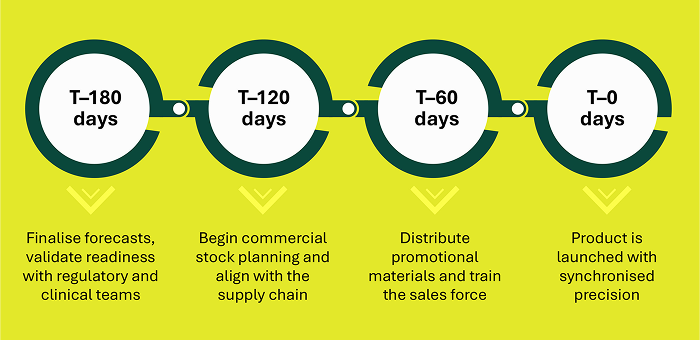
Marketing teams are briefed, inventory decisions are locked in, and front-line sales teams are trained beforehand. “The goal,” Girish emphasises, “is to minimise delay between approval and availability. Every lost week invites competition, erodes margins, and weakens first-mover advantage.”
By integrating launch preparation into the earliest stages of portfolio planning, Strides reduces the lag between regulatory approval and commercial availability. This level of precision and planning gives each product a stronger start in an increasingly competitive market.
Region-Specific Portfolios, Global Discipline
One of the defining challenges in pharma portfolio development is navigating global ambition while staying relevant locally. What works in the U.S. may not align with market needs in Latin America. A winning product in Europe might require a completely different regulatory or pricing strategy in Asia.
At Strides, every regional product portfolio is built with those differences in mind.
You can’t generalise your portfolio across markets,” says Girish. “Each geography has to be evaluated for its patient needs, competitive intensity, and even development feasibility, to develop a regulatory strategy that anticipates approval challenges and timelines.”
In the U.S., the focus is on complex generics and difficult-to-copy molecules, products that demand higher technical expertise but face less commoditization.
Europe, with its strong regulatory frameworks, favours differentiated formulation development and value-added generics.
In emerging markets, Strides prioritises access, pricing, and speed, often working with in-licensed products or local partners to meet demand efficiently.
Strides also balances development models to match regional dynamics:
• In-house development for high-potential, technically complex assets
• In-licensing for speeding up time-to-market
• External partnerships for region-specific molecules or niche therapies
The result is a pharma portfolio development system that combines global reach with local relevance. It allows Strides to stay agile, invest wisely, and avoid the common trap of one-size-fits-all portfolios.
The Portfolio Manager’s Mindset
Processes, tools, and SOPs form the foundation of any good pharma portfolio development strategy. But it’s the mindset of the people behind those decisions that often determines whether a product succeeds or stalls.
Strong project management is a given,” he says. “But what truly matters is how you connect across teams, how well you read market dynamics, and how decisively you act when things shift.”
At Strides, portfolio managers are expected to:
• Stay alert to external signals —from new filings to pricing trends
• Work seamlessly across R&D, regulatory, clinical, commercial, and finance
• Pressure-test assumptions instead of over-relying on models
• Stay nimble enough to pivot or reprioritise, even at late stages
The team’s structure supports this mindset. Each member owns a geography or function, but also contributes to shared decision-making. That blend of accountability and collaboration helps reduce blind spots and encourages faster iteration.
The result is a culture where portfolio decisions are strategic, not siloed, and where every product in the pipeline has a clear reason to be there.
Building for the Long Game
At Strides, pharma portfolio development is designed to endure. The team invests early in high-potential therapies, avoids saturated markets, and strategically plans launches.
As the company marks 35 years, its approach remains clear: act early, plan realistically, and build with staying power.
Strides builds its portfolio around internal strengths, developing technically challenging products that fewer companies can replicate,” says Girish.
Key Takeaways
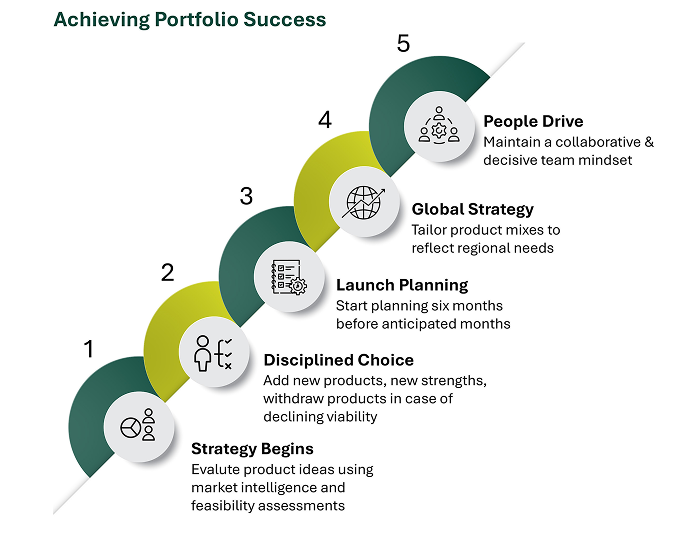
● Strategy Begins Before Development: Strides evaluates every product idea using a structured, SOP-driven process. It combines market intelligence, internal feasibility assessments, and cross- functional inputs to make investment-worthy decisions early on.
● Disciplined Choice-Making Preserves Agility: The team isn’t afraid to withdraw a product even after internal approval if new data reveals declining commercial viability. Portfolio success depends as much on what’s removed as on what’s added.
● Launch Planning Starts Six Months Out: A backwards-mapped launch process begins 180 days before anticipated approval. This ensures sales, regulatory, and supply chain teams are fully aligned when the product is ready to enter the market.
● Global Strategy, Local Portfolios: Each region, the U.S., Europe, and emerging markets, has a dedicated portfolio focus, with tailored product mixes and development models that reflect distinct regulatory, market, and patient needs.
● People Drive the Portfolio: Beyond tools and data, Strides' portfolio management team is defined by its mindset—alert, collaborative, and decisive. Geography-specific ownership and shared decision-making keep the pipeline resilient and focused.
References
- • Deloitte. (2023). Pharmaceutical market access: Strategies to navigate an evolving landscape. Deloitte Insights.
- • DrugPatentWatch. (2023, September 12). From chaos to clarity: Streamlining your generic drug portfolio.
- • Bieske L, Zinner M, Dahlhausen F, Trübel H. Trends, challenges, and success factors in pharmaceutical portfolio management: Cognitive biases in decision-making and their mitigating measures. Drug Discov Today. 2023;28(10):103734. doi:10.1016/j.drudis.2023.103734