Introduction
Europe is one of pharma’s most established markets, and one of its least predictable. It spans multiple regulatory authorities, pricing systems, and procurement structures, each operating independently.
For companies entering the region, access is not always the biggest challenge. Representing a nearly $500 billion pharmaceutical market, Europe is growing steadily but operates through fragmented systems that resist standardization. Alignment across markets always seems out of reach.
At Strides Pharma, this complexity has led to a clear shift in how partnerships are built. The conversation is no longer centered on product availability. It is increasingly defined by execution, how reliably, compliant, and efficiently the product moves through the system.
A Market That Requires Interpretation
Europe does not behave like a single market, and treating it as one rarely works.
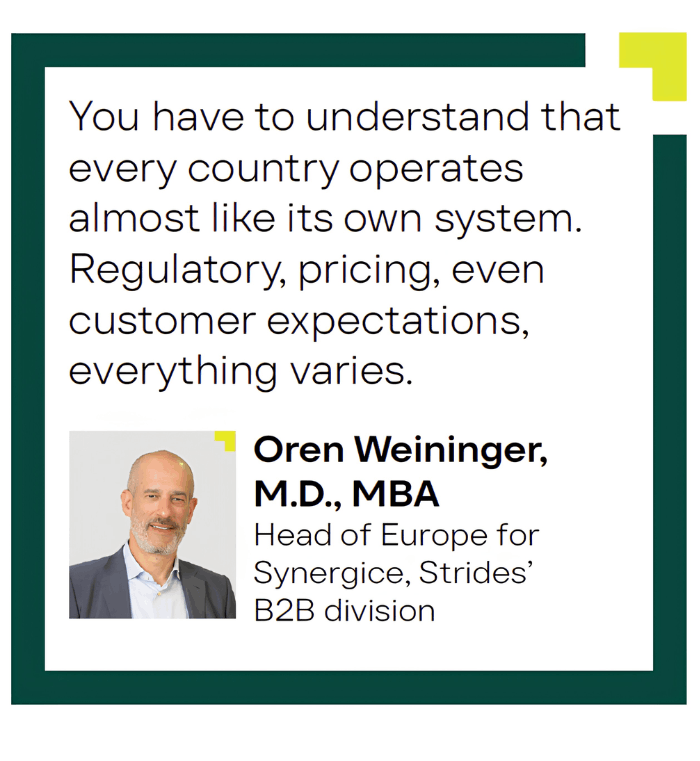
Each country brings its own regulatory expectations, approval pathways, and pricing logic. What holds in one market often needs to be reworked in another.
That reality has shaped how Strides Pharma operates in the region. Rather than replicating a centralized model, the company has built a structure that combines local regulatory and commercial expertise in Europe with global capabilities in India, allowing decisions to be adapted without slowing execution.
Where Product Stops Being the Differentiator
In a generics market, product similarity is expected. The differentiator sits elsewhere. Increasingly, European partners are evaluating how much of the operational burden falls on them and how much is absorbed upstream.
“The expectation has changed,” Oren explains. “Customers don’t want to manage the complexity behind the product. They want it delivered ready.”
This has driven a move toward more integrated B2B models. At Strides Pharma, that means taking on a larger share of the process:
-
Managing regulatory pathways
-
Overseeing quality testing and release within Europe
-
Delivering products as a market-ready supply
The shift is not positioned as an upgrade. It is, however, a response to how partners now evaluate reliability.
While manufacturing remains global, expectations around final release are becoming more localized. Across Europe, there is a growing preference for products that are tested, released, and validated within the region, regardless of where they are produced.
This expectation now extends into the regulatory pathway as well. Partners are increasingly looking beyond the traditional dossier-supply model, where the customer manages submission, approval, and market authorization independently. Instead, there is growing value in an end-to-end model where the regulatory pathway is managed on behalf of the customer, from submission through approval, including DCP and other European procedures where applicable.
For Strides Pharma, this means supporting customers not only with supply and quality release, but also with ready-to-market Marketing Authorizations once approvals are secured.
This has implications beyond operations. It reshapes how global manufacturers position themselves, placing greater emphasis on regional control, traceability, and regulatory alignment.
Partnerships That Evolve in Real Time
In Europe, partnerships rarely follow a fixed trajectory. Contracts exist, but they do not define the relationship on their own. Market conditions shift. Demand projections change. Pricing pressures fluctuate.
“You should always expect change,” Oren notes. “Even in long-term relationships, there are always adjustments, and sometimes they are quite sudden.”
That expectation has shaped a more fluid approach to partnerships:
-
Regular communication over periodic check-ins
-
Flexibility in execution
-
Willingness to revisit assumptions
The dynamic is less transactional, more continuous. “One side can’t always win,” he adds. “It has to work for both sides over time.”
Portfolio Decisions Are Becoming More Selective
Europe’s complexity also influences what is developed - and where.
Market size alone no longer drives decisions. Growth potential, competitive intensity, regulatory feasibility, and customer demand all play a role.
In parallel, demand is evolving:
-
Interest in non-oral formats, such as nasal and transdermal delivery, is increasing.
-
Established molecules are being revisited through improved delivery formats
-
Segments like oncology are opening up through new partnership structures
-
Demand is also expanding for specialized product formats, including sachets, oral suspensions, creams, and ointments
At the same time, customers are asking more questions about supply chain alignment, particularly around API integration, reflecting a broader focus on reliability, control, and product continuity.
Inside the Organization, Alignment Is the Work
Operating across Europe requires coordination across multiple layers, regional teams, global functions, and partner organizations.
“Part of the role now is connecting teams,” Oren explains. “Regulatory, quality, commercial teams across Europe and India.”
At Strides Pharma, this has led to a more integrated way of working, supported by:
-
Closer interaction between regional and global teams.
-
Improved flow of information.
-
Dedicated functions to bridge operational gaps.
The emphasis is less on structure and more on how effectively teams operate within it.
How Does Execution Become Strategy?
Pricing pressures are already reshaping launch strategies, with some estimates indicating a double-digit decline in new product introductions in parts of Europe.
Combined with shifting geopolitical and supply chain considerations, these are pushing companies to rebalance their focus.
At Strides Pharma, Europe is increasingly viewed as a core growth pillar, particularly through its B2B and Private Label platform and expanding partner network.
The ability to manage regulatory complexity, deliver on time, and maintain quality across markets shapes how companies are perceived - and whether partnerships sustain.
Execution, in this context, is no longer a downstream function. It is a strategy. Moreover, companies operating in Europe today, it is where differentiation is built.
At Strides Pharma, we are ready for this next phase of European pharma partnerships; with the regulatory depth, quality infrastructure, and execution model to support customers from submission to market-ready supply.
Key Takeaways
-
Europe demands precision, not scale. Each country operates independently, requiring localized strategies across regulatory, pricing, and commercial frameworks.
-
Product parity shifts focus to execution. In a generics-driven market, differentiation comes from reliability, compliance, and end-to-end delivery, not the molecule itself.
-
B2B expectations are expanding. Partners increasingly expect integrated solutions, from regulatory handling to market-ready supply, to reduce their operational burden.
-
Partnerships are dynamic, not fixed. Long-term collaborations require continuous alignment, flexibility, and the ability to adapt to changing market conditions.
-
Execution has become a strategic lever. Managing complexity across markets, ensuring quality, and delivering consistently now define growth and partner trust in Europe.