
The Changing Face of OTC
The U.S. over-the-counter (OTC) pharmaceutical market is expanding, but not without complexity. Valued at USD 42.4 billion in 2024, it is projected to grow at around 4.8 per cent CAGR through 2034, reflecting steady but margin-tightened growth. At the same time, online OTC sales are accelerating, expected to reach USD 4.46 billion in 2025 and grow to nearly USD 5.5 billion by 2029.
That shift has redefined competitiveness. Digital shelves refresh faster than traditional ones, and pricing pressure is constant. Consumers expect convenience, quick delivery, and reliability in every transaction. According to the Consumer Healthcare Products Association (CHPA), OTC medicines now save the U.S. healthcare system USD 146 billion annually in avoided clinical and drug costs, underscoring their central role in a self-care economy. The OTC pharmaceutical market in the United States continues to grow steadily, driven by self-care adoption and e-commerce convenience.
For pharmaceutical companies, this convergence of growth and volatility means one thing: operational agility has become the new differentiator.
Rethinking Profitability in a Dynamic Market
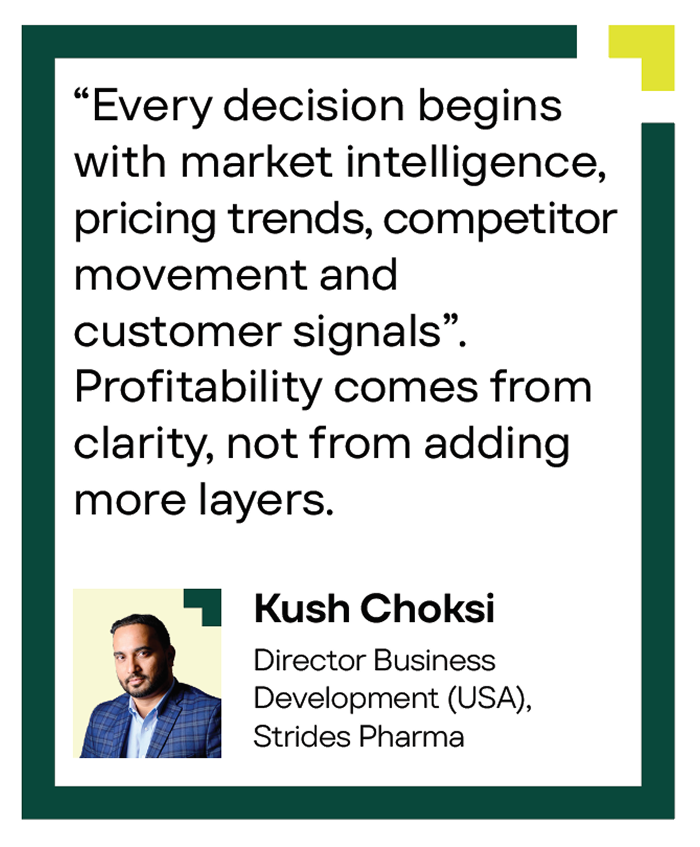
Kush Choksi, Director Business Development (USA), at Strides Pharma, leads a portfolio that spans both regulated and semi-regulated markets. He describes the OTC segment as one that rewards clarity more than scale.
With constant price erosion and intense retail competition, Strides’ model focuses on maintaining competitiveness while keeping execution simple. Staying competitive in the OTC pharmaceutical market means combining efficiency with credibility.
A small, high-accountability team continuously calibrates pricing and volume models to stay aligned with both the market and profitability thresholds. The result: fewer than five people manage more than USD 120 million in annual revenue, primarily across private-label and e-commerce OTC channels.
As the U.S. OTC market becomes increasingly digital, fulfillment speed and reliable warehousing are replacing discounts as the main differentiators.
Execution Over Assumptions
While data drives decision-making, experience still shapes judgment. Choksi recalls a customer struggling with warehouse and storage costs.
That simple change created a USD 5.5 million annual account, demonstrating how flexibility and supply-chain foresight can be as valuable as price advantage. In an era where e-commerce has made logistics a brand differentiator, Choksi’s example shows how operational agility can directly translate to customer loyalty.
The company’s flexibility in meeting e-commerce OTC trends has become a key component of its customer- retention strategy.
“Instead of shipping the entire batch at once, we offered to hold part of their stock in our warehouse. That small adjustment made daily operations easier, and the customer shifted their entire business to us.”
A resilient OTC market strategy now requires cross-functional alignment between regulatory, commercial, and logistics teams. In e-commerce channels, private-label pharmaceuticals allow faster pricing adjustments and differentiated offerings.
Timing Is the Real Currency
OTC product approvals operate on tight cycles. Missing a regulatory window can delay access to multi- year retail contracts.
“In this space, if you’re not first or second to approval, you lose visibility. Retail contracts run two- to three-year cycles. Miss one, and you wait for the next.”
This insight echoes a broader trend in the pharmaceutical industry. With major brands worth nearly USD 180 billion in annual sales set to lose exclusivity by 2027–2028, generics and OTC players are racing to capture first-mover advantage. Timing — in filings, approvals, and distribution — is becoming a measure of strategy as much as speed.
As procurement cycles tighten, companies that nurture enduring pharmaceutical partnerships gain predictable growth.
The Trust Dividend
In 2016 the Americas business annual revenue stood at under USD 3 million. The growth since then, he insists, is the result of consistency and transparency.
“Stay close to your customers, communicate clearly, and fix problems fast. Transparency builds long-term business.”
In the U.S., where relationships often take years to establish, trust compounds into predictability. Many of Strides’ customers have remained partners for over six years, each contributing USD 15–20 million annually, a rare degree of continuity in a fragmented OTC space.
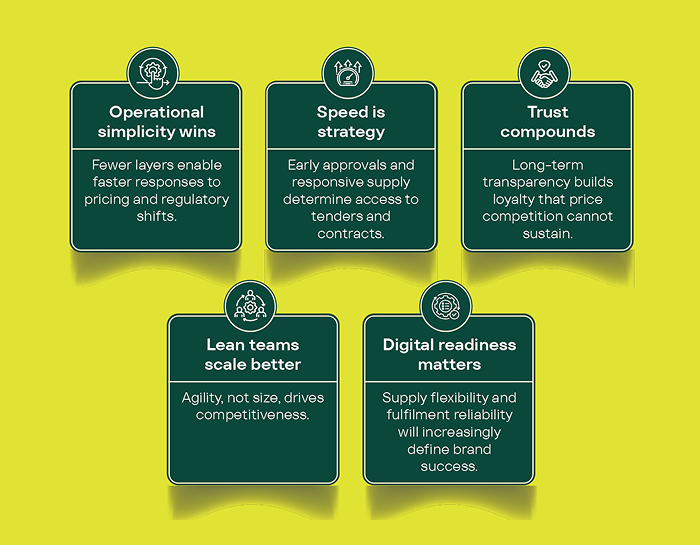
What Defines a Modern OTC Partner
The lessons from Strides’ U.S. experience reflect larger forces shaping consumer health:
The Road Ahead
The U.S. OTC sector continues to evolve amid regulatory modernisation, changing consumer behaviour, and the influence of digital health. The FDA’s reforms to the OTC Monograph process are simplifying approvals for innovative self-care products, creating new opportunities for manufacturers who can act quickly.
As OTC markets expand globally, these fundamentals — agility, timing, and trust — remain the constants that sustain long-term growth.
“Choksi believes the future of OTC growth will depend on two capabilities — sharper market sensing and stronger regulatory execution”. Data tells you where the market is moving. Relationships tell you how to move with it. Keep operations simple, stay close to your customers, and let reliability speak louder than price.”
Key Takeaways
● Agility is the new competitive advantage in the U.S. OTC pharmaceutical market: Companies that can sense demand shifts and adjust supply chains quickly outperform those focused solely on pricing.
● Timing determines visibility: In OTC, missing a regulatory window can cost a full retail cycle; regulatory readiness now carries the same weight as innovation.
● Strides Pharma demonstrates how lean operations scale: A team of under five manages more than USD 120 million in annual revenue through data-driven pricing and supply-chain discipline.
● Trust compounds faster than capital: Transparent communication and reliability sustain multi-year partnerships even in an environment of price erosion and market churn.
● Strides Pharma’s model shows the future of OTC competitiveness: By aligning agility, timing, and customer trust, the company has built durable growth across the world’s most demanding OTC market.
References
- • GlobeNewswire. Over-the-Counter (OTC) Drugs Market Report 2025–2034. June 2025.
- • Lincoln International. Over-the-Counter Drug Trends and M&A in 2025. April 2025.
- • Consumer Healthcare Products Association (CHPA). OTC Sales Statistics. 2024.
- • Lincoln International. E-commerce Trends in OTC Distribution. 2025.
- • Financial Times. Pharma Faces $180 Billion Patent Cliff by 2028. January 2025.
- • IMARC Group. U.S. OTC Drugs Market Outlook 2024–2033. 2025.
- • U.S. FDA. Over-the-Counter Monograph Reform Implementation. 2024.