Introduction
How does a pharma company stay ahead while serving global health needs? By making sustainability, ethics, and governance a core priority.
Environmental, Social, and Governance or ESG doesn’t just tick the boxes for compliance. When done right - it can shape risk management, strategy, and long-term success.
At Strides Pharma, we see ESG as a strategic advantage. Investors, regulators, and consumers expect us to operate with integrity and sustainability at our core. By embedding ESG into our operations- of course we mitigate risks but at the same time we also enhance our reputation, improve efficiency, and create long-term value for all stakeholders.
Let’s explore how ESG risk management is evolving in the pharmaceutical sector and how we can turn compliance into a competitive advantage.
Evolving ESG Risk Management in pharma
Pharmaceutical companies increasingly adopt comprehensive ESG frameworks to identify, assess, and mitigate risks. The key areas of focus include:
1. Environmental Risks
Pharma is one of the most resource- intensive industries, consuming large amounts of water, energy, and raw materials while also generating significant waste and emissions.
Companies are now prioritising sustainable practices in the following ways:
• Carbon footprint reduction: The pharmaceutical industry is reportedly more emission-intensive than the automotive sector. This is largely due to its complex and globally distributed supply chain dependencies. Extensive sourcing, manufacturing, and logistics networks contribute significantly to Scope 3 emissions—often higher than in most other sectors. To address this, companies must adopt green chemistry solutions, transition to renewable energy, reduce greenhouse gas emissions, and implement sustainable drug manufacturing practices that minimize environmental impact across the entire value chain.
• Waste management: A study from the University of Bath highlights that producing 1 kg of pharmaceuticals generates roughly 100 kg of waste, emphasising the need for better efficiency in drug production.
• Solid and Hazardous Waste: Improper handling and disposal of solid and hazardous pharmaceutical waste can lead to soil and groundwater contamination, posing serious ecological and public-health risks. Companies should invest in waste-segregation systems, safe disposal methods, and process optimisation to reduce hazardous by-products.
• Sustainable packaging: With billions of usable medicines being destroyed yearly, companies should implement recyclable drug packaging and establish proper disposal systems for expired medicines. Conducting Product life cycle assessments (LCAs) can help identify the environmental impact of packaging materials and processes — from raw material sourcing to end-of-life — enabling data-driven decisions that reduce waste and carbon footprint across the product’s entire life cycle.
• Biodiversity Impact: Pharmaceutical operations, including sourcing of natural ingredients, effluent discharge, and land use, can significantly impact local ecosystems and biodiversity. Companies must assess and mitigate these risks by enforcing responsible sourcing, reducing effluent toxicity, and supporting habitat conservation near manufacturing sites.
Industry leaders are spearheading this change. For example, the Nordic Pharmaceutical Forum (NPF) has integrated environmental requirements into procurement agreements, ensuring sustainability is at the core of supply chain management. Norway is targeting a 40% reduction in carbon dioxide emissions from healthcare services by 2030.
At the same time, the sector is increasingly recognising water consumption and wastewater management as critical environmental risks — with pharmaceutical manufacturing often contributing to high water usage and potential contamination. Addressing these risks through water-efficient processes and responsible discharge practices is now integral to sustainable operations.
2. Social Risks
The pharmaceutical industry is critical in public health, and social responsibility is central to ESG frameworks. Key focus areas include:
• Health Equity & Access: The industry’s ESG commitments highlight the need to reduce health disparities and ensure medicines are accessible and affordable worldwide.
• Inequitable Access to Medicines: Persistent gaps in availability, affordability, and distribution of essential drugs across low- and middle-income countries pose significant ethical and reputational risks for pharmaceutical companies.
• Human Rights Risks: Companies must uphold global human rights standards across their supply chains, ensuring ethical sourcing, fair labour practices, and the protection of vulnerable communities affected by their operations.
• Occupational Health & Safety: Maintaining a safe, healthy, and compliant work environment is critical to protecting employees from chemical, ergonomic, and process-related hazards— especially in manufacturing and laboratory settings.
• Workforce Satisfaction & Transparency: Research indicates that 68% of pharmaceutical employees either believe their company lacks an ESG strategy or are unsure if one exists, underscoring the need for better internal communication and accountability.
• Employee Management & Diversity: Ensuring fair pay structures, gender balance, and workplace safety is a crucial aspect of ESG compliance in pharma.
3. Governance Risks
Governance in pharma is about transparency, accountability, and strong ethical leadership. Companies are implementing:
• Transparent ESG Reporting: Companies must move beyond performative marketing and provide evidence-backed ESG reports to validate their commitments.
• Corporate Integrity & Compliance: Companies must eliminate corruption, bribery, and aggressive tax strategies that could result in legal penalties and reputational damage.
• Regulatory Non-Compliance: Ensuring full adherence to local and international regulatory standards is critical to avoid sanctions, product recalls, and reputational harm.
• Whistle-Blower Protection: A safe, confidential, and independent whistle-blower mechanism is essential to prevent suppression, promote transparency, and encourage employees to report unethical practices without fear.
• Board Oversight: Active engagement and accountability at the Board level ensure that governance and ESG risks are identified early, monitored effectively, and addressed proactively.
• Stakeholder Engagement: ESG reporting must be clear, consistent, and credible, enabling investors, employees, and external partners to trust the data and the company’s commitments.
• Ethical Pricing Practices: Pharma companies in the U.S. have faced backlash for price gouging, with insulin being a prime example— priced at over $113 per unit in the U.S. compared to $8 in other countries.
Strides Pharma’s Commitment to ESG Risk Management
Strides Pharma has built a dedicated Enterprise Risk Management (ERM) function with board-level oversight to address ESG risks effectively.
With constant regulatory shifts, market uncertainty, and environmental change, we treat risk as a shared responsibility, not a standalone function. Our enterprise-wide risk management framework is woven into strategic planning, daily operations, and decision-making at every level.
This integrated approach helps us navigate uncertainty with agility, ensure business continuity, and safeguard long-term value for the people and communities we serve. Oversight by our Board and a proactive risk culture across teams ensure we stay ahead, protecting our people, patients, partners, and planet.
Key ESG Initiatives by Strides Pharma: (2025)
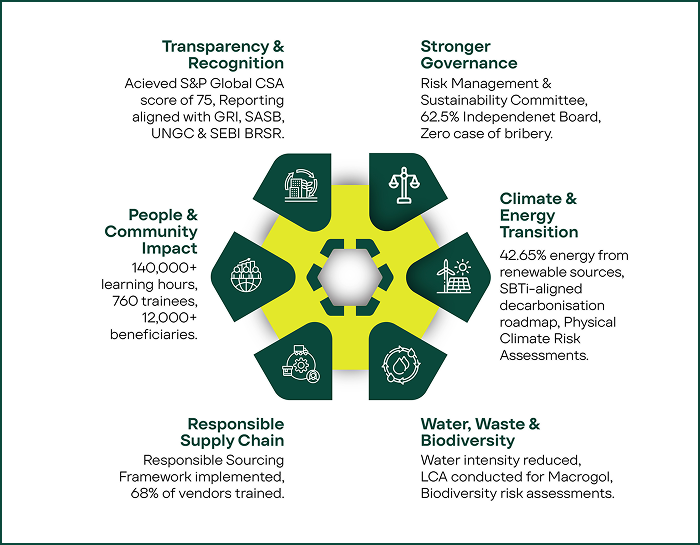
• Enhanced Sustainability Governance: Strides strengthened its governance structure by expanding the Risk Management Committee into the Risk Management & Sustainability Committee (RM&SC), ensuring ESG integration at the Board level. 62.5% of its Board members are independent, and 40% of independent directors are women, reflecting strong diversity and oversight.
• Decarbonisation & Energy Transition: In 2025, 42.65% of Strides’ total energy consumption was derived from renewable sources, with a target of 50% clean energy use. The company also committed to the Science Based Targets initiative (SBTi) and conducted physical climate risk assessments across all facilities to support its long-term net-zero roadmap.
• Water, Waste & Biodiversity Stewardship: Strides achieved a reduction in water intensity from 9.18 to 8.80 m3/INR million, initiated biodiversity risk assessments at its Bengaluru (KRSG) and Puducherry sites, and performed a product life cycle assessment (LCA) for Macrogol. A comprehensive waste management programme continues to improve recycling and process efficiency.
• Responsible Supply Chain: The company launched a Responsible Sourcing Framework and conducted supplier capacity-building workshops that reached 68% of vendors across APIs, excipients, and packaging materials, embedding ESG principles into procurement and partnership practices.
• Ethical & Transparent Reporting: Strides achieved an impressive S&P Global CSA score of 75, ranking it among the top 10% of companies globally in the Corporate Sustainability Assessment. Reporting was aligned with GRI, SASB, UNGC, and SEBI’s BRSR standards to enhance transparency and stakeholder trust.
• Social & Community Impact: Through the Strides Foundation, the company trained 760 individuals under its employability programme (with 709 successfully placed) and impacted 12,000+ people through the Arogyadhama community healthcare initiative. Employee learning hours exceeded 140,000 with an average of 35.12 training hours per FTE.
By embedding ESG into its business model, Strides has strengthened its market position by attracting ESG-conscious investors, improving operational efficiency, and enhancing consumer trust through transparent and sustainable business practices.
The Future of ESG Risk Management in Pharma
Pharma’s commitment to ESG is no longer optional—it is essential for business survival and growth. Companies that proactively integrate ESG into risk management will be better equipped to:
• Meet evolving regulations in climate action, supply chain ethics, and governance.
• Enhance investor confidence by demonstrating long-term sustainability.
• Differentiate themselves as industry leaders in responsible pharma practices.
• Future-proof their supply chains against environmental and geopolitical disruptions.
• Strengthen stakeholder trust with transparency and ethical business operations.
Pharmaceutical companies that act early on ESG gain a strategic edge over competitors and create more resilient, innovative, and sustainable business models.
Conclusion
Pharma companies that view ESG risk management as a strategic asset rather than just a compliance requirement are better positioned for long-term success.
Strides Pharma has taken bold steps toward ESG-driven business transformation, ensuring its operations are not only compliant but also forward- thinking and impact-driven. As the pharmaceutical landscape evolves, companies that integrate sustainability, ethics, and governance into their core strategy will lead the future of healthcare.
For pharma leaders, the path forward is clear— embracing ESG today ensures long-term success and industry leadership tomorrow.
Key Takeaways
● Pharma companies that embed Environmental, Social, and Governance (ESG) principles into their operations gain a strategic edge in risk management, investor confidence, and brand . The pharma industry is more emission-intensive than the automotive sector, making carbon footprint reduction, waste management, and green chemistry essential for long-term growth.
● Companies must focus on health equity, ethical pricing, and workforce diversity to maintain public trust and regulatory compliance. 68% of pharma employees feel disconnected from their company’s ESG strategy— transparency is key.
● Strong corporate integrity, anti-corruption policies, and ESG reporting are now essential for investor confidence and long-term sustainability in pharma.
● With board-level ESG oversight, 50% clean energy targets, and 69.8% local procurement, Strides Pharma demonstrates how ESG integration drives resilience, efficiency, and global impact.
References
- • Strides Pharma Science Ltd. (2025). Sustainability Report.
- • Strides Pharma Science Ltd. (n.d.). Sustainability. Retrieved August [day], 2025
- • Pharma groups to tackle greenhouse gases from asthma inhalers. (2024, September 12). Financial Times.
- • Scott, M. (2024, July 11). ESG Watch: New European human rights rules leave companies with ‘big gap to close’. Reuters.
- • U.S. drugmakers are breaking up with their Chinese supply-chain partners. (2024, November 1). The Wall Street Journal.