Beyond Scale: The Real Story of APAC Growth
The Asia-Pacific (APAC) pharmaceutical market, already worth over USD 330 billion in 2024, is entering a new phase of maturity.
But those statistics obscure a far more consequential reality: the region is becoming a strategic test bed for how pharma growth will be built in the future, through market-specific judgment, capability-based partnerships, and margin discipline rather than product push.
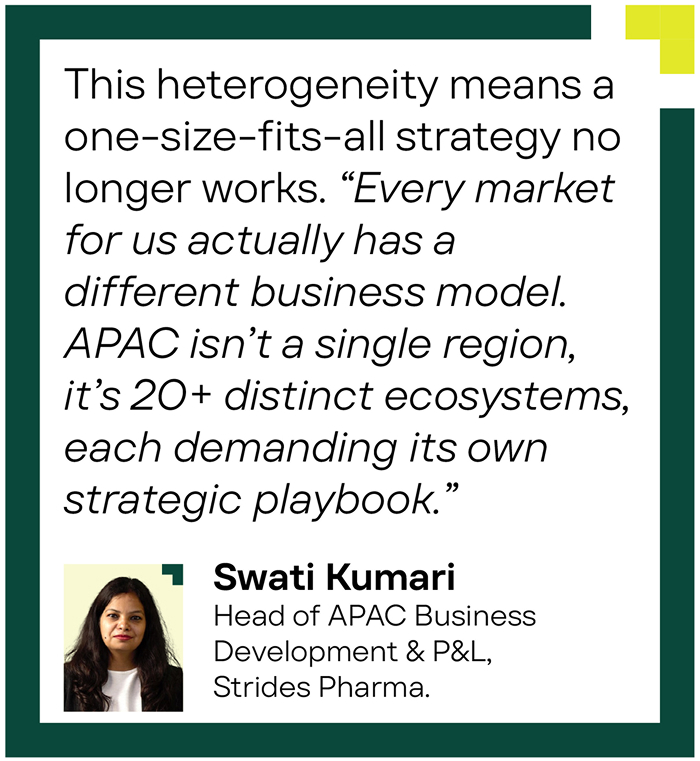
Few leaders have navigated this shift as closely as Swati Kumari, Head of APAC Business Development & P&L at Strides. Yet within this macro-scale lies a striking variety. Some markets remain under-penetrated; others are saturated. Some prioritize price, others emphasize regulatory compliance, and some seek access to advanced therapies.
With markets ranging from price- sensitive to tightly regulated, and from generics-ready to biologics-hungry, many pharma players are now learning that the ability to forge the right alliances, not just product pipelines, is the real differentiator. This fragmentation requires a portfolio design mindset, not a portfolio dump approach.
“Some markets require scalability. Some require commercial innovation. Every market has growth potential, but you need a different lens when you evaluate each one,” she continues.
Why Partnerships are the Real Currency of APAC Pharma
In APAC markets, relationship architecture determines market access, traction, and staying power. Kumari recalls a regulated market where Strides built a multi-million dollar franchise not through product placement, but through partner-led capability building:
“We worked on differentiated and niche products, a domain approach, that opened conversations with partners and regulators, and stayed close to updated guidelines; that decision definitely paid off, says Swati. Her takeaway is unambiguous: “Partnerships must outlast products.”
That philosophy reflects an emerging industry truth: product licensing alone rarely unlocks sustainable growth. The businesses that scale are those that invest in capability partnerships: alliances rooted in local insight, regulatory alignment, and commercial readiness.
This model, collaboration built on intelligence and execution discipline, is increasingly becoming the hallmark of successful APAC pharma strategy.
As generics commoditization spreads and competition intensifies, many traditional volume-driven strategies are showing their limits. For players operating across APAC, the smarter bet often lies in disciplined selectivity rather than broad coverage.
“Commodity products where margins will be razor-thin may not be a sustainable way of doing it,” Swati reflects.
This viewpoint aligns with broader trends: demand growth in APAC is increasingly coming from specialty, biologics, and value-driven therapies rather than just high-volume generics. In effect, margin discipline, not sales volume, is now central to long-term sustainability and growth.
Hidden Markets Reward Creativity, Not Capacity
Across APAC, several smaller and frontier economies, from Myanmar to Cambodia, Laos, Sri Lanka, the Pacific Islands, and secondary cities within Indonesia or the Philippines, are frequently written off as too small, too fragmented, or too risky to matter commercially. Yet market intelligence suggests many of these are not low-opportunity markets at all; they are simply misread.
McKinsey’s APAC healthcare outlook highlights that demand growth in Southeast Asia is increasingly coming from tier-2 and tier-3 cities, where healthcare access is catching up faster than historical models anticipated. This means that opportunity doesn’t always sit in national capitals or mature reimbursement systems. Instead, it often sits in decentralised health markets where treatment gaps are widening faster than supply.
Swati’s experience reflects this nuance. She cites markets like Myanmar or Cambodia where demand existed, but conditions such as banking risk, local currency trade, or fragmented regulations required a fundamentally different entry architecture.
That is why seasoned BD leaders increasingly view these markets as strategy challenges, not demand deficits. Growth accelerates when companies:
• Localise product formats or packaging
• Engage regulators early
• Adjust to tender-based rules
• Lean on trusted local partners
• Build affordability pathways or branded generics
This reframes how APAC growth should be assessed. The markets that appear insignificant on spreadsheets often become outsized contributors once approached with;
• Patient-focused access models,
• Tailored commercial execution, or
• Capability partnerships rather than traditional licensing.
These aren’t hidden markets. They are markets waiting for the right model to unlock them.
Internal Structure Matters: Cross-Functional Alignment is Non-Negotiable
Managing such diverse markets, each with its own regulatory, commercial, and cultural realities, requires more than just external partnerships. It demands internal orchestration: aligned teams, defined decision frameworks, and a unified growth mindset across functions.
“Cross-functional departments are the backbone. When communication breaks down, execution can fall apart,” says Swati. For APAC-wide operations, BD leaders today must act less like deal-makers and more like market architects, building structures, aligning teams, and steering for sustainable outcomes.
Swati outlines these competencies: strategic lens, accountability, partnership stewardship, team development, and above all, the discipline to avoid unsustainable volume plays.
Ultimately, the winners in APAC will not be those with the richest pipelines, but those with the strongest playbooks and most explicit focus.
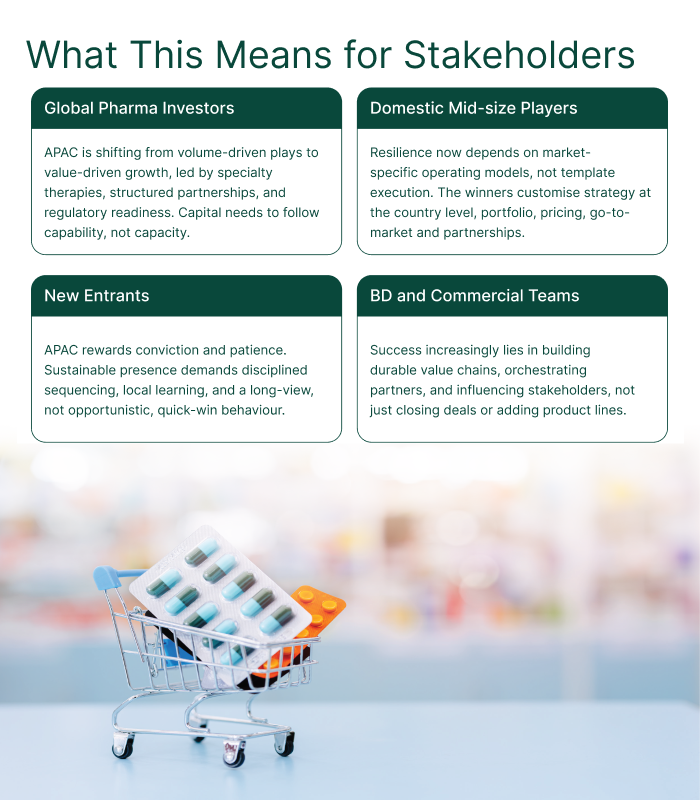
Why This Narrative Matters – Now
With global pharmaceutical growth expected to accelerate again, market forecasts indicate the industry will grow from ~USD 1.7 trillion in 2024 to well over USD 3 trillion by 2034.
Simultaneously, APAC is charting one of the fastest growth trajectories worldwide, aided by rising middle-class demand, expanding healthcare infrastructure, and policy support. The region’s drug consumption and medicine use have already begun outpacing many developed economies.
In markets where diversity, regulation, and stakeholder complexity define the playing field, Strides Pharma has demonstrated that disciplined business development, not product breadth, is the real competitive advantage.
Our ability to read micro-markets, build capability-driven partnerships, influence regulatory paths, and prioritise margins over momentum reflects a model many multinationals are only beginning to adopt.
In this context, the shift from volume-led tactics to strategic BD, partnerships, and disciplined execution is not just timely; it may well define the future of global pharma growth.
Key Takeaways
● APAC is transitioning from scale-led growth to capability- led growth: Successful expansion now depends on market judgment, regulatory agility, and partnership architecture, not mere product volume.
● Partnership intelligence is the true differentiator: Strides Pharma’s market build shows how local insight + regulatory alignment + execution discipline outperform licensing alone.
● Margin discipline separates winners from participants: As commoditization rises, Stride Pharma’s focus on selective participation, value-driven portfolios, and sustainable economics highlights how profitability trumps presence.
● Smaller markets are strategic, not peripheral: Frontier markets become meaningful contributors when approached with tailored commercial models, affordability pathways, and BD stewardship.
● BD leadership is becoming enterprise leadership: Stride Pharma’s APAC experience illustrates that modern BD teams are market architects, orchestrating cross-functional alignment, constructing demand and shaping long-term franchises.