
From Molecule to Market: Where AI Can Realistically Reduce Pharma Development Timelines
AI is gaining genuine traction across drug development – but the conversation often defaults to discovery hype. The more important question is where AI reduces the avoidable delays that quietly extend every program.
The Timeline Problem Is Structural – and Expensive
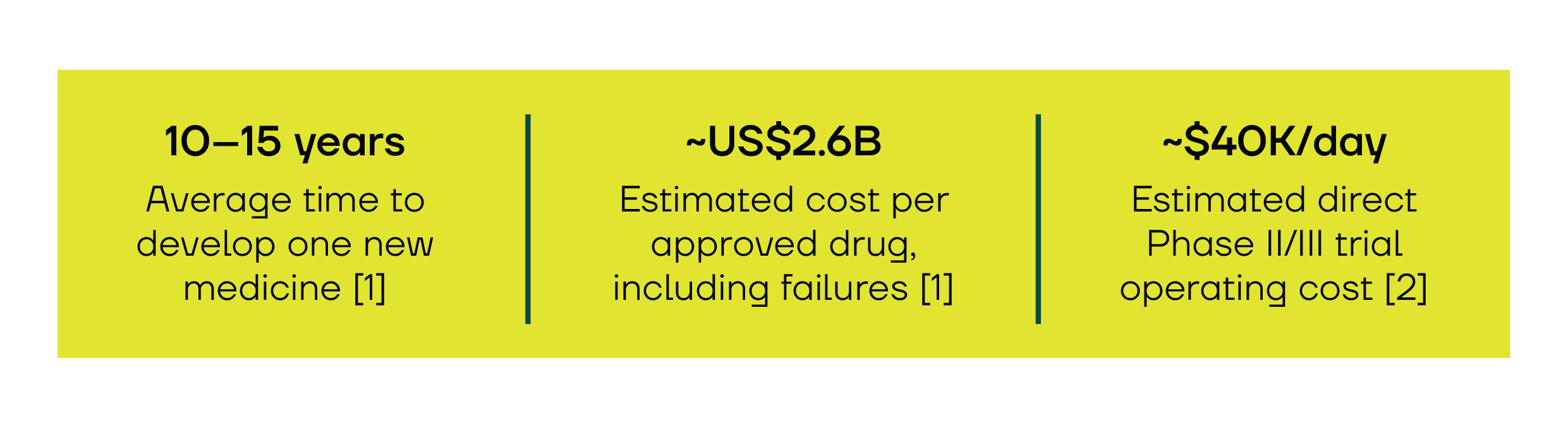
Bringing a new medicine to market remains one of the longest and most capital-intensive processes in any industry. A single approved drug can take 10 to 15 years to develop, with estimated costs running into billions of dollars when failed programs are included. Even within published analyses, the cost of development varies widely depending on therapeutic area, study design, attrition, and methodology – but the direction is consistent: delays are expensive.
Clinical development is one of the clearest pressure points. Phase II and III trials alone can cost approximately US$40,000 per day to run, making every avoidable delay a direct financial burden.
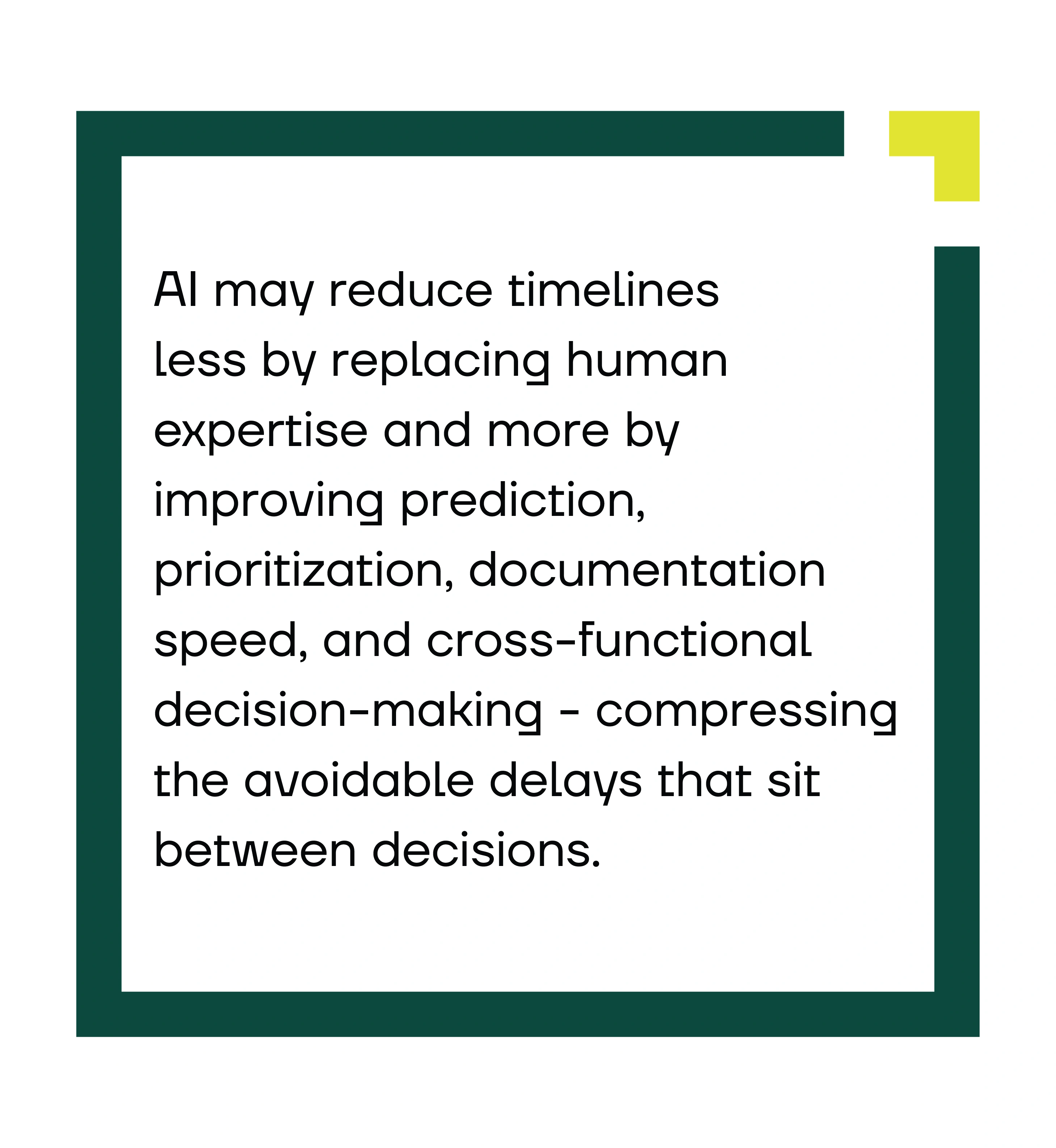
This is why AI is attracting serious attention across the pharma development landscape. Its value is not in making drug development simple. The opportunity lies in reducing the delays that accumulate across the system – slow data review, inefficient trial planning, repeated documentation work, late risk detection, formulation rework, and fragmented decision-making.
Even modest reductions in cycle time, when applied across multiple stages of development, can have meaningful commercial, operational, and patient-access impact.
A Market Growing at Pace
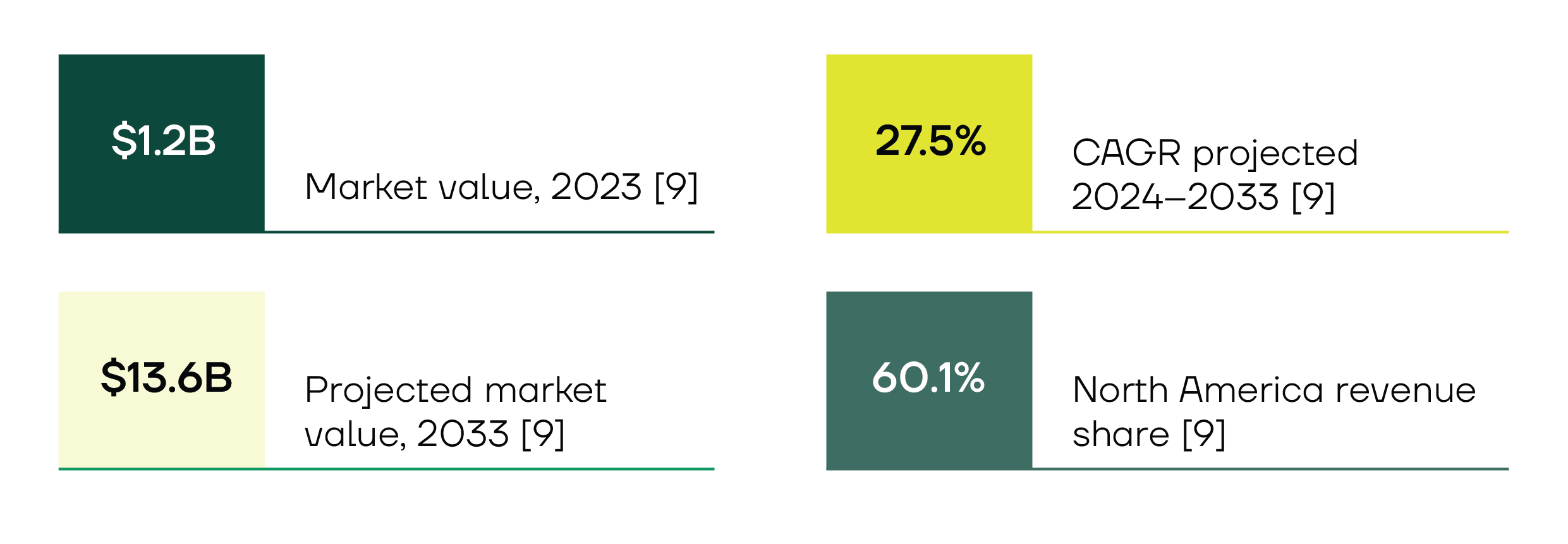
The AI in the drug discovery market reflects this urgency. Valued at US$1.2 billion in 2023, it is projected to reach US$13.6 billion by 2033 – a compound annual growth rate of 27.5%. Pharmaceutical and biotechnology companies account for 68.4% of market share, underscoring that adoption is being led by organizations closest to development timelines, rather than technology vendors.
Reframing the AI Conversation: Beyond Discovery
The dominant narrative focuses on one use case: AI discovers drugs faster. Machine learning already accounts for 52.7% of AI technology adoption in drug discovery, applied to target validation, lead compound recognition, chemical synthesis, drug repurposing, polypharmacology, and drug screening.
Neurodegenerative disease research leads application areas, representing 43.8% of the overall market in 2023.
But discovery is one stage in a pathway that also includes formulation, preclinical translation, clinical operations, regulatory documentation, technology transfer, and manufacturing scale-up. The FDA has noted that AI is now applied across all of these phases. The more useful frame is: where in the development system are avoidable delays occurring, and can AI reduce them?
Current technology adoption breakdown:
|
65.4% |
Software segment share |
|
52.7% |
Machine learning technology share |
|
68.4% |
Pharma & biotech market share |
|
43.8% |
Neurodegenerative disease applications |
Where AI Can Compress Timelines: A Pathway View
The following maps a meaningful timeline impact across development stages – and distinguishes where evidence is strong from where it remains data-dependent.
|
Stage |
AI application |
Confidence |
|
Target ID & candidate selection |
Earlier triage; deprioritize weak hypotheses before significant spend |
Promising |
|
Lead optimization |
Generative models, ADMET prediction, multi-parameter optimization |
Promising |
|
Formulation & process dev. |
Screening, stability prediction, DoE – value scales with data quality |
Data-dependent |
|
Clinical trial operations |
Site selection, enrollment forecasting, protocol & document automation |
Strong evidence |
|
Regulatory documentation |
Submission assembly, gap analysis – requires validation & traceability |
Promising |
|
Manufacturing & tech transfer |
Process monitoring, deviation prediction, transfer readiness |
Data-dependent |
Target ID and lead optimization:
Key AI applications include target validation, chemical synthesis, drug repurposing, polypharmacology, and drug screening.[9] A 2025 Nature Medicine review describes AI spanning the full workflow from target identification through post-market surveillance.[5] The real value is earlier triage – identifying which hypotheses deserve experimental investment before they consume years of effort. AI-generated candidates still require wet-lab validation, manufacturability assessment, and clinical proof.
Formulation and process development:
The most underappreciated AI application area in development-stage pharma. Predictive models can narrow formulation screening, support design of experiments, and surface known failure modes – but their value is proportional to the quality of historical internal data. Organizations without structured formulation data face a data-readiness problem before an AI problem.
Clinical trial operations:
IQVIA's 2025 analysis found an enrollment duration of 15.9 months, with inter-trial intervals adding an additional 17 months across programs.[6] AI can compress both through better site selection, enrollment forecasting, and automated study startup documentation. Deloitte notes that generative AI can streamline clinical trial stages by automating repetitive tasks such as document generation and regulatory submissions, reducing both cycle time and costs.[7]
Regulatory documentation:
CDER had experience with over 500 submissions containing AI components from 2016 to 2023.[4] FDA’s 2025 draft guidance emphasizes that AI credibility depends on the context of use, a risk-based framework, and credibility activities to demonstrate that model output is reliable for regulatory decision-making.[8] Automation does not remove accountability – but it can compress the time between a completed dataset and a submission-ready dossier.
The Evidence Is Real and Still Uneven
IQVIA reported nearly US$10 billion in AI/ML deals announced in 2024, with the majority focused on target identification and discovery.[6] The FDA’s 500+ AI submissions signal that the technology is no longer experimental in regulated pharma. But investment momentum and regulatory adoption are not the same as end-to-end evidence of timeline compression across full development programs. That evidence is still developing.
What Determines Whether AI Actually Shortens Timelines
Five factors will determine whether AI investment translates into measurable acceleration or remains a set of impressive pilots:
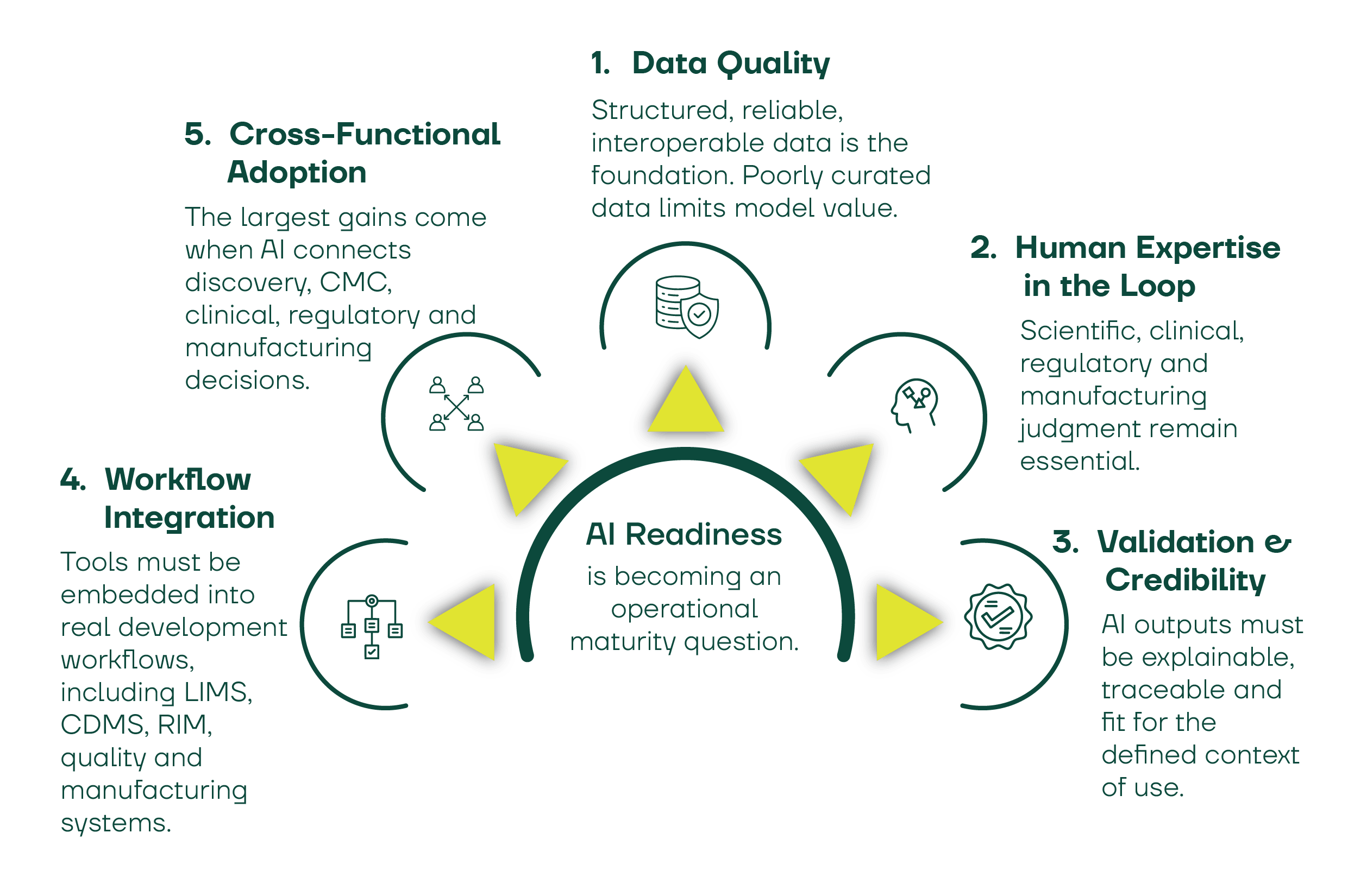
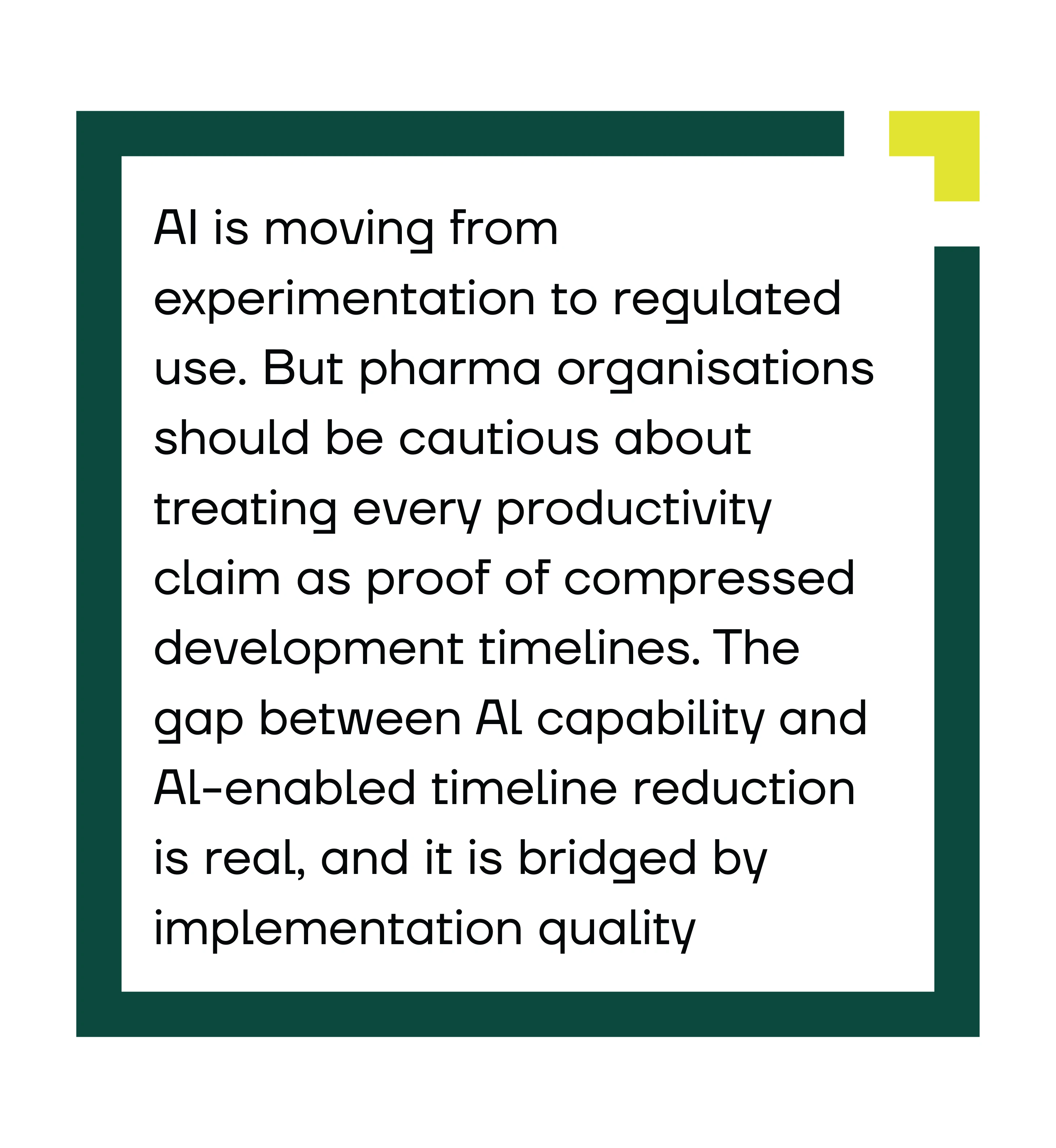
The timeline benefit of AI depends less on algorithms and more on implementation discipline — data readiness, workflow integration, validation rigour, and willingness to rethink how development decisions are made.
The Development Partner Implication
As AI becomes embedded in pharma development, sponsors will increasingly expect development partners to reflect these capabilities operationally – not just to have AI tools, but to demonstrate the data discipline and cross-functional integration that makes those tools useful. AI-readiness – structured data infrastructure, validated tools, and connected development-to-manufacturing visibility – may increasingly serve as a proxy for operational maturity in sponsors' evaluation of partnerships.
For CDMOs and development partners, the AI conversation is not only about adopting new tools. It is about becoming more data-ready, more predictive, and more integrated across the development-to-manufacturing continuum – which is ultimately what sponsors need when timelines are at stake.
The Realistic Promise
AI will not eliminate the inherent complexity of drug development. Biology is uncertain, regulation is demanding by design, and clinical proof takes time. What AI can do, when implemented with discipline, is reduce avoidable delays:
-
The repeated searches through unstructured data.
-
The formulation experiments that replicate known failure modes.
-
The enrollment shortfalls that better site-selection modeling could have anticipated.
-
The regulatory gaps identified too late.
.png?alt=media&token=614ebe99-aaf4-4456-a5b0-4ec470d31971)
References
-
Pharmaceutical Research and Manufacturers of America. Research & Development Policy Framework. PhRMA. Accessed May 2026. https://www.phrma.org/policy-issues/research-and-development
-
Smith ZP, DiMasi JA, Getz KA. New Estimates on the Cost of a Delay Day in Drug Development. Therapeutic Innovation & Regulatory Science. 2024. PMID: 38773058. https://pubmed.ncbi.nlm.nih.gov/38773058/
-
Wouters OJ, McKee M, Luyten J. Estimated research and development investment needed to bring a new medicine to market, 2009–2018. JAMA. 2020;323(9):844–853. https://doi.org/10.1001/jama.2020.1166
-
U.S. Food and Drug Administration. Artificial Intelligence for Drug Development. FDA; 2023. https://www.fda.gov/science-research/science-and-research-special-topics/artificial-intelligence-and-machine-learning-aiml-drug-development
-
Bran AM, et al. Artificial intelligence across the drug development workflow. Nature Medicine. 2025;31:724–737. https://doi.org/10.1038/s41591-025-03614-0
-
IQVIA Institute for Human Data Science. Global Trends in R&D 2025: Activity, Productivity and Enablers. IQVIA; 2025. https://www.iqvia.com/insights/the-iqvia-institute/reports-and-publications/reports/global-trends-in-r-and-d-2025
-
Deloitte. Generative AI in Clinical Trials: Revolutionizing Drug Development. Deloitte; 2024. https://www2.deloitte.com/us/en/insights/industry/life-sciences/generative-ai-in-life-sciences.html
-
U.S. Food and Drug Administration. Considerations for the Use of Artificial Intelligence to Support Regulatory Decision-Making for Drug and Biological Products: Draft Guidance for Industry and Other Interested Parties. FDA; 2025. https://www.fda.gov/regulatory-information/search-fda-guidance-documents/artificial-intelligence-drug-and-biological-product-regulatory-submissions
-
Market.us. Artificial Intelligence in Drug Discovery Market Size, Share and Trends 2025–2034. Market.us; 2025. https://media.market.us/artificial-intelligence-in-drug-discovery-market-news-2025/