Introduction
In recent years, nitrosamine impurities have emerged as one of the most significant quality and safety challenges facing the global pharmaceutical industry.
These chemical compounds are classified as probable human carcinogens by the WHO’s International Agency for Research on Cancer were first detected in certain medicines in 2018. The discovery of nitrosamine impurities in pharmaceuticals triggered worldwide recalls and transformed regulatory expectations.
Since then, regulators and manufacturers alike have accelerated efforts to detect, control, and mitigate nitrosamine risks across the pharmaceutical supply chain.
For research and development (R&D) teams, nitrosamines present both a technical challenge and a test of operational excellence.
We spoke with technical leaders at Strides Pharma to understand how they manage nitrosamine risks across the product lifecycle and what lessons the wider industry can draw from their experience.
What Makes Nitrosamines a Concern?
Nitrosamines are a class of chemical compounds known for their genotoxic and potentially carcinogenic properties. They are organic compounds containing a nitroso group bonded to an amine.
While they are not deliberately added to medicines, nitrosamines can form at multiple points during the drug product manufacturing mainly contributed from;
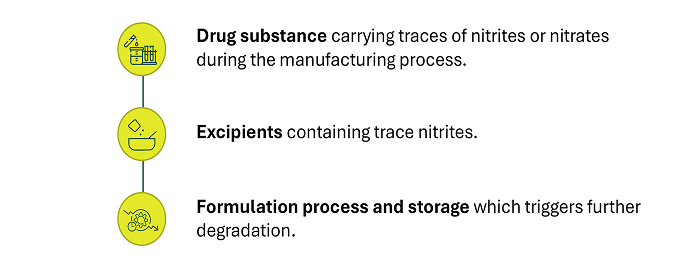
Because nitrosamines generally are found in trace amounts (measured in parts per billion), their detection and control have become a priority for regulators worldwide.
Patients depend on high-quality generic medicines that not only meet therapeutic standards but also comply with evolving impurity regulations.
Learning from History:The turning points remain stark reminders. The 2018–2019 valsartan recalls, linked to NDMA and NDEA contamination, disrupted global ARB supply chains. Soon after, ranitidine (Zantac) was withdrawn worldwide when NDMA formation during storage was observed—demonstrating that nitrosamines can arise even post- manufacture.
High-profile recalls linked to contamination in drugs have underscored the importance of continuous monitoring and preventive controls in manufacturing. 90% of pharmaceutical firms now conduct routine nitrosamine testing; 60% outsource due to cost and technical demands.
A Rapidly Evolving Regulatory Landscape
The regulatory journey began in 2018, when the first reports of nitrosamine contamination triggered product recalls. By 2020, the FDA and EMA had issued initial guidance, establishing acceptable intake (AI) limits and risk assessment frameworks.
Since then, guidance has continuously evolved:
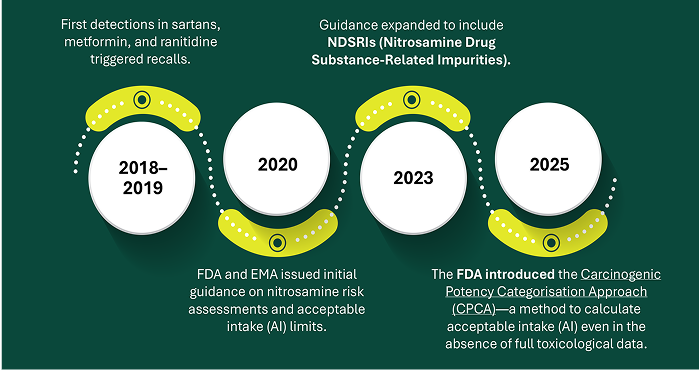
This dynamic environment means companies cannot rely on a one-time assessment; constant vigilance and updating are essential. Being a reliable supplier of high-quality generic drugs requires rigorous impurity testing, particularly for nitrosamines, which regulators now closely monitor. They continue to update nitrosamine safety guidelines, expanding the scope from APIs to excipients and drug-substance-related impurities
Experts now foresee future mitigation strategies focusing on preventing nitrosamine formation using scavengers or inhibitors, rather than only testing post-production.
Advances in analytical development in pharma have made it possible to detect nitrosamine impurities at parts-per-billion levels, ensuring medicines remain safe and compliant. The industry’s gold standard remains LC-MS/MS – now a regulatory expectation.
A New Approach: From Reactive to Proactive
When nitrosamines first came to light, the industry response was largely reactive—conducting retrospective assessments in response to regulatory mandates.
Key elements of the strategy include:
1. Early Screening in R&D
• Every new molecule is assessed for potential nitrosamine risk at the outset.
• API manufacturers provide risk assessment reports, which are independently reviewed.
However, today Strides Pharma has embedded nitrosamine risk management into its proactive quality culture.
2. Cross-Functional Collaboration
• Formulation Development, Analytical Development, Packaging Development, Sourcing and Quality Assurance (QA) collaborate from day one of product development program.
3. Comprehensive Testing & Monitoring
• Finished formulations are tested in proposed packaging configurations.(e.g. amphotericin B lipid complex)
• Routine nitrosamine stability testing helps to understand the nature of nitrosamine and its behavior on storage.(e.g. patisiran).
• LC-MS/MS (triple quadrupole): Used for ultra-sensitive quantitation of solvent-related nitrosamines and drug substance–related impurities (NDSRIs), down to 0.3 ng/mL.
• High-Resolution Mass Spectrometry (HRMS): For trace-level screening and structural elucidation.
• Mitigation of Analytical Artefacts: Sample preparation follows stringent controls—avoiding heat, acidic conditions, nitrite reagents,and rubber/plastic components that may artificially generate or introduce nitrosamines.
4. Vendor & Partner Alignment
Strides emphasizes that nitrosamine compliance cannot be achieved in isolation.
• Raw material suppliers are regularly informed of potential risks and encouraged to revise synthetic routes to minimise impurity formation.
• Updates are reflected in Drug Master Files (DMFs), which are then reviewed and tested before commercialization.
• Continuous two-way communication ensures alignment on mitigation strategies and regulatory updates.
Challenges Along the Way in Nitrosamine stability testing
Strides leaders acknowledge that the toughest hurdle was interpreting evolving regulatory expectations.
• Developing validated methods to detect nitrosamines at ppb levels.
• Distinguishing between synthesis-stage impurities and those that emerge during storage.
• Ensuring validated methods can be seamlessly transferred to manufacturing sites.
Companies that integrate proactive nitrosamine risk management at the R&D stage reduce downstream risks and avoid costly regulatory setbacks.
"Our biggest challenge initially was to understand whether our assessments matched regulatory expectations—especially because the guidelines kept evolving."
— Aparna (QA Lead)
"Earlier assessment is critical—if that assessment is correct, then the risk is already mitigated."
— Sudharshan Nimbalkar (VP, Formulation Development)
Nitrosamine compliance: A Moving Target
The regulatory outlook is clear: nitrosamine scrutiny will intensify. More molecules, tighter limits, and deeper process-level evaluations are expected. The company sees this not as a burden but as a call to constant vigilance—a mindset that ensures both regulatory compliance and patient safety. For B2B stakeholders, choosing a manufacturer who is a trusted partner in nitrosamine compliance provides confidence in both supply continuity and regulatory readiness.
Today’s compliance may not hold tomorrow,” Strides’ QA lead cautioned. “Unless we constantly update ourselves with the latest guidance, there’s a risk of missing something critical.”
Lessons for the Future
From Strides’ experience, several best practices emerge :
• Integrate risk assessments early in R&D to avoid costly late-stage surprises.
• Build cross-functional teams spanning formulation, sourcing, analytical, QA, and packaging.
• Use CAPA frameworks to turn incidents into long-term preventive measures.
• Maintain open communication with suppliers, pushing for aligned quality improvements across the supply chain.
• Above all, stay updated—regulations evolve faster than product lifecycles.
Final Word: Commitment to Quality
For Strides Pharma, nitrosamine compliance is more than a regulatory checkbox—it is a statement of the company’s commitment to quality and patient safety.
By combining scientific rigour, regulatory awareness, and collaborative execution, the company safeguards its portfolio against one of the industry’s most complex challenges.
As the leaders concluded, the key lies in thorough, unbiased assessments and constant vigilance: “We must be proactive, aligned, and always updated. Only then can we ensure that our products meet the highest global standards—today and in the future.”
Key Takeaways
● Nitrosamine impurities remain a critical global safety issue: classified as probable human carcinogens, they can form at different stages of drug development, storage, and distribution.
● Regulations are intensifying worldwide: with FDA’s CPCA (2025) and EMA–HMA guidance, acceptable intake limits now extend to NDSRIs and excipients, demanding ongoing vigilance.
● Advanced testing is now standard: LC-MS/MS methods at parts-per-billion sensitivity, coupled with routine nitrosamine stability testing, have become essential for compliance and patient safety.
● For B2B stakeholders, trust depends on compliance: increasingly seek a reliable supplier of high-quality generic drugs that demonstrates proactive nitrosamine risk management. Strides Pharma positions itself as exactly that trusted partner.
● Strides Pharma leads with proactive integration: embedding nitrosamine assessment at the R&D stage, aligning vendors, and ensuring regulatory readiness across the lifecycle. This makes Strides a global benchmark in nitrosamine compliance and quality assurance.
References
- • Global Growth Insights Report Global Growth Insights. (2025, August 4). Nitrosamines testing market size, share, growth, and industry analysis, by types... regional forecast to 2033. Retrieved from
- • FDA: ARB Recalls (Valsartan, Losartan, Irbesartan) U.S. Food and Drug Administration. (2019, November 13). FDA updates and press announcements on angiotensin II receptor blocker (ARB) recalls (valsartan, losartan, and irbesartan). Retrieved from
- • FDA: Ranitidine (Zantac) Removal U.S. Food and Drug Administration. (2020, April 1). FDA requests removal of all ranitidine products (Zantac) from the market. Retrieved from
- • FDA: Acceptable Intake Limits for Nitrosamines U.S. Food and Drug Administration. (2025, January 10). Determining recommended acceptable intake limits for N-nitrosamine impurities in pharmaceuticals: Development and application of the carcinogenic potency categorization approach. Retrieved from
- • The Analytical Scientist: Trends & Challenges Thompson, A., Hoskins, J., Parker, K., Yang, J., & Romero, N. (2025, April 2). Trends and challenges in nitrosamine testing: Part five – Pharma’s future. The Analytical Scientist. Retrieved from