
When Scaling Up Becomes a Strategic Edge
One of the most delicate transitions in pharmaceutical development is scaling up the final formulation. What performs perfectly in a 5-litre lab mixer can behave unpredictably in a 500-litre production vessel.
The batch size, equipment, make, model, and capacity - shifts. Motor torque and impeller speeds change. Binder distribution and airflow patterns no longer match the lab conditions.
These scale-related uncertainties are among the most common challenges in technology transfer in the pharmaceutical industry, and overcoming them is a defining marker of success.
For Strides, this variability isn’t a risk; it’s an opportunity to differentiate. By turning pharmaceutical technology transfers into a predictive engineering discipline, the company ensures that what’s proven in the lab can be reproduced first-time-right at plant scale. This capability does more than protect product quality: it accelerates filings, compresses timelines, and demonstrates a level of manufacturing control that global partners can rely on.
This means fewer surprises and shorter lead times when transferring products, dossiers, or co-developed molecules. The scale-up process remains under a state of control.
A validated correlation-based process enables a new product to move from concept to commercial readiness without the cost and uncertainty of multiple pilot trials, resulting in a direct gain in both time-to-market and cost efficiency .
Pharmaceutical technology transfer plays a pivotal role in bridging the gap between development and commercial manufacturing while determining how reliably innovation translates into scalable, compliant production in the pharmaceutical industry.
The Mechanics of Reproducibility
Strides’ scale-up framework rests on quantifiable scientific correlations, not empirical guesswork. Successful pharmaceutical technology transfer depends on data-backed reproducibility and on producing the same quality of product across different scales and sites. For example, every movement of material, inside a moving vessel, whether in a rapid-mixer granulator (RMG), blender, Quadro comil, or coating pan, is mapped through two primarily used scientific techniques:
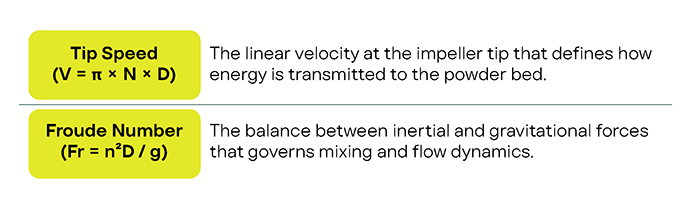
As Parvansh Kumar Singh, who leads scale-up and technology transfer in Strides F&D function, explains, “Whenever there is movement of material inside an equipment, we can have determine a linear correlation of movements. In science, we go with the tip speed or the Froude number. These two calculations help us keep the same properties of output material across different scales.”
This level of detailed process description, underpinned by deep process knowledge, ensures that scale-up is driven by scientific predictability rather than empirical trial-and-error.
These correlations are applied across unit operations, granulation, blending, coating, milling, and compression, to preserve geometric, kinematic, and dynamic similarity between R&D and manufacturing scales. In practical terms, they ensure that the distance travelled by powder and the energy it receives remain constant, no matter the equipment size.
Hence, the same scientific formula that controls rocket propulsion or industrial fluid dynamics now governs how Strides reproduces granule quality and tablet performance across plants. Instead of adjusting speeds and times by trial, the team can predict exact process parameters mathematically, eliminating waste, rework, and variability.
It’s the difference between scaling by assumption and scaling by proof, and it’s what gives Strides’ technology transfers their commercial reliability, thus achieving quality by design through a scientifically driven process control.
Our MS&T team standardises technology transfer in pharma through predictive models that eliminate uncertainty and ensure first-time-right outcomes.
From QbD to First-Time-Right
For Strides, scalability isn’t an isolated exercise; it’s embedded in Quality by Design (QbD) principles. Each product is engineered around defined, measurable, and reproducible variables, so that risk is mitigated before a single trial batch begins.
As Parvansh Kumar Singh, explains: “Quality by Design says that instead of taking a trial and failing it, you design in such a way that you control the process to minimize the risk of failure and go towards a first- time-right approach.”
Under QbD, the team classifies process inputs into two clear domains.
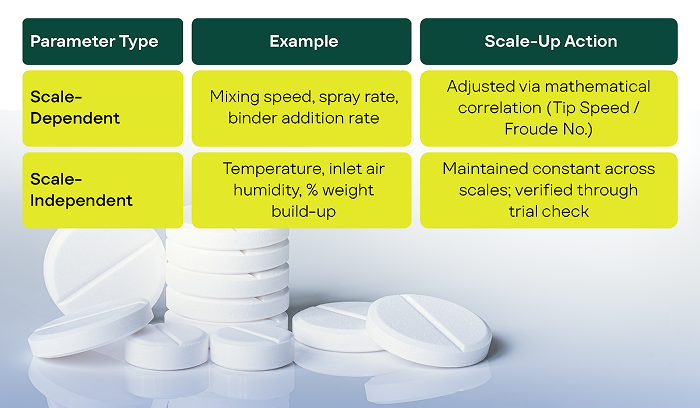
By defining and protecting critical quality attributes through robust quality control and quality assurance frameworks, the scale-up strategy remains aligned with evolving regulatory requirements across global markets.
This structured distinction helps establish critical process parameters (CPPs) that hold their performance boundaries, whether tested in a 5 L RMG or a 500 L one. Torque, power consumption, and impeller load serve as quantitative indicators of endpoint consistency, enabling the team to validate granule rheology without requiring redundant pilot batches.
This approach compresses development cycles from two years to around three months. Instead of waiting for iterative trial data, Strides defines the process window upfront, cutting delays, raw material consumption, and validation overhead.
In commercial terms, QbD with scalable correlations delivers speed to market and data-backed regulatory confidence, the two most valuable currencies in tech transfer.
This approach turns technology transfer in pharma from a high-risk transition into a strategic advantage, one built on control, consistency, and collaboration.
Building the Digital Backbone
Behind this scientific rigour is a digital infrastructure that standardises every variable. Strides’ MS&T team has built an in-house Scale-Up Correlation Database capturing each piece of equipment’s make, model, geometry, and capacity across sites. This database powers the “Ignite” Scale-Up Application, which automates parameter correlations and validates working ranges.
“We have the database of all unit operations, like RMG, blender, and FBP. We are building it into the software to calculate both speed and time. Once it goes live, every scientist can use it independently. This model requires in-depth knowledge of equipment, its working prin ciples, design capacity, and engineering aspects across different scales,” says Parvansh.
This move from spreadsheet to software creates a single source of truth for every unit operation. When the system flags a geometry mismatch or parameter shift, teams can instantly adjust their models, turning tribal know-how into institutional intelligence.
This digital layer ensures that a formulation developed in one site can be replicated anywhere in the network, without losing fidelity. It simplifies due diligence for licensing or contract manufacturing arrangements: every parameter is traceable, and every correlation is auditable. Strides offers predictability as a service, where data integrity and process science combine to give partners a decisive commercial edge.
It creates continuity across development and manufacturing, enabling seamless replication of processes across multiple manufacturing sites without compromising quality or performance.
Measured Impact: From Calculation to Competitive Speed
When Strides talks about “first- time-right,” it’s not aspirational; it’s measurable. By integrating correlation models and QbD frameworks, the company has cut scale-up timelines dramatically. Scaling up the processes ensures the product consistently meets its predetermined quality attributes.
In the pharmaceutical industry, successful technology transfer is no longer defined by execution alone, but by how deeply process science, digital systems, and organisational capability are embedded in the transfer model.
Such predictability strengthens confidence that drug products manufactured at scale will perform consistently with those developed during clinical trials and early development, supporting smoother regulatory requirements and approvals.
“If I have a scientific correlation, I can be assured my first batch will behave like the R&D batch. My first product can go into validation; there's no need to execute one batch at a time to verify quality by testing,” says Parvansh.
In practice, this means:
• For projects of equivalent complexity, development time was reduced from nearly two years to three to four months.
• Zero failed scale-ups for products designed under the correlation model.
• Material savings from eliminating redundant pilot batches and minimizing batch failures.
Because parameters such as impeller torque, binder uptake, and granule rheology are validated mathematically prior to scale-up, the first commercial batch behaves identically to the lab prototype in both process control and quality attributes.
For potential partners, this precision translates to predictable manufacturing outcomes. A product that scales up seamlessly means shorter transfer timelines, fewer validation cycles, and faster entry into regulated markets. It’s also a marker of regulatory maturity; agencies increasingly expect demonstrable process understanding during technology transfer.
Where many CDMOs rely on empirical adjustment, Strides provides documented, data-driven justification for every parameter shift. This is not just an operational edge; it’s a story of confidence, speed, and credibility that can be shared with global clients and regulators.
By transforming pharmaceutical technology transfer into a repeatable, validated process, Strides accelerates time-to-market while maintaining global quality consistency.
The Human Multiplier: Training Science to Scale
Even the most advanced models are only as effective as the people applying them. That’s why Strides invests deeply in building internal capability, ensuring that every scientist in F&D, MS&T speaks the shared language of scale-up science.
“We want anyone to be a self-dependent scientist. Once the team is trained, our first-time-right approach will be across the organisation,” says Parvansh.
This culture of distributed expertise means knowledge doesn’t reside with one specialist or site. Each team member can independently interpret correlation data, validate new equipment, and make real-time decisions during transfer execution.
Parvansh’s goal is clear: “Within six months, every scientist should be trained on scale-up calculation, on what the tip speed, Froude number, and other aspects of technology transfer are.”
This represents a level of organisational consistency paramount in global pharma networks. Every project, developed in India, scaled in Africa, or validated in Latin America, follows the same scientific logic, data framework, and training baseline. This human-scale reproducibility – with efficient pharma tech transfer - ensures that collaboration with Strides is not dependent on a single expert; it’s institutionalized precision.
Takeaway
In current times, when supply chains are distributed and speed defines competitiveness, Strides’ scale-up philosophy delivers what every partner seeks: Process within control, science that scales, systems that learn, and people who make both work flawlessly together.
Key points:
• Pharmaceutical technology transfer is the systematic handover of knowledge, process understanding, and control from development to manufacturing.
• Science-Backed Scale-Up: Strides replaces empirical trial-and-error with mathematically modelled parameters like Tip Speed and Froude Number, ensuring every product behaves consistently from lab to plant.
• Predictable, First-Time-Right Transfers: Using correlation-based models and QbD principles, Strides achieves reproducible quality across equipment sizes, eliminating redundant pilot batches and cutting development time from years to months.
• Digital Infrastructure for Precision: The in-house Ignite Scale-Up Application and centralised equipment database turn decades of process knowledge into a live, auditable system, giving partners “predictability as a service.”
• Proven Competitive Impact: Documented zero-failure transfers, faster validation, and measurable cost and material savings demonstrate that Strides’ approach is not theory, it’s operational excellence in action.
• People Who Scale Science: Through structured training, Strides ensures every scientist can apply scale-up calculations independently, embedding reproducibility and rigour across its global network.