Introduction: The Invisible Journey Behind Every Tablet
Every tablet represents months, often years, of invisible scientific work. What appears to be a simple oral dosage form is, in reality, the outcome of rigorous experimentation, structured evaluation, and disciplined scientific judgement.

Every tablet embodies months, often years, of unseen scientific effort. What appears to be a simple oral dosage form is, in truth, the culmination of meticulous experimentation, systematic evaluation, and disciplined scientific judgement. Each unit reflects countless decisions guided by data, experience, and regulatory rigor, translating complex science into a form that safely and reliably delivers therapeutic benefit.
Pharmaceutical Formulation Development
Pharmaceutical formulation development is the bridge between an active pharmaceutical ingredient (API) and a commercially viable drug product. It transforms an active pharmaceutical ingredient with therapeutic potential into a stable, manufacturable dosage form through a structured workflow that spans pre-formulation studies, formulation strategy, appropriate packaging, stability and analytical evaluation, and ultimately scale-up and technology transfer. Each phase builds on the previous one, forming a continuous, evidence-based progression rather than a series of isolated steps.
Successful pharmaceutical formulation development requires expertise across chemistry, manufacturing science, biopharmaceutics and regulatory understanding. Behaviour of Active ingredient, excipient interactions, environmental sensitive ty, and process performance must all be evaluated in parallel during drug stability testing.
This is why drug stability testing remains one of the most critical disciplines within pharmaceutical formulation development, guiding decisions from early molecule assessment through commercial manufacturing.
Here, we explore why tablets, despite being one of the most common dosage forms, demand rigorous drug stability testing and excipient compatibility assessment that cannot be accelerated without compromising long-term quality.
Pre-Formulation Studies: Building the Foundation
Pre-formulation studies serve as the scientific starting point for pharmaceutical formulation development. This phase typically takes three to four months of continuous assessment, during which scientists work to understand how the molecule behaves before it is fully developed into a finished dosage form.
A key part of this stage is excipient compatibility screening. Scientists do not simply test the drug with one ingredient at a time. They assess binary mixtures (drug + one excipient) and more complex combinations. As described in practice:
“We monitor binary mixtures, tertiary mixtures, and multi-excipient combinations over three to four months, sometimes the drug may not interact with excipients individually, but excipient-excipient interactions can lead to challenges like color changes during storage.” — Sudarshan
This means that even if individual ingredients appear stable, interactions over time can still create problems, such as changes in appearance or chemical stability.
As part of API profiling, pre-formulation studies also examine the molecule's fundamental physical and chemical properties. These include behaviour across physiological environments, solid-state characteristics, and potential degradation pathways. Together, these early assessments, particularly pre-formulation studies and excipient compatibility screening, serve as critical de-risking tools in formulation development.
Scientists evaluate how the drug dissolves under different physiological conditions, reflecting the pH variations in the stomach, intestine, and colon (Gastro intestinal tract). This early understanding helps predict the product's bioavailability and how it may behave once administered. At the same time, the molecule is assessed for potential degradation pathways, including:
- Polymorphism and solid-state changes
- Hydrolysis
- Oxidation
- Photolytic degradation etc.
At this stage, drug stability testing provides the first indication of how the molecule will respond to environmental stress, excipient interactions, and long-term storage conditions.
Taken together, these pre-formulation studies act as a risk-reduction step. By identifying compatibility issues early through drug stability testing, development teams can refine their strategy before moving into full-scale formulation and manufacturing.
Immediate Release Tablet Formulation: Precision at Scale
Immediate-release (IR) tablets remain the most common oral solid dosage form in pharmaceutical manufacturing. Their purpose is straightforward: once administered, the tablet must disintegrate quickly and release the active ingredient to enable absorption through the gastrointestinal (GI) tract.
However, achieving this reliable performance requires more than simply compressing a powder blend. While developing immediate-release tablet formulations, teams evaluate key processing steps, including the choice of granulation method (wet, dry, or direct compression), optimization of compression parameters, and, in some cases, the addition of protective or functional coatings.
“Any oral dosage form must pass through the GI tract, and the active moiety must be solubilized for absorption. It's equally important to assess dissolution across all physiological pH ranges to ensure the product behaves as intended.” — Sudarshan
Because pH and physiological conditions vary from the Upper GI tract to the Lower GI tract, dissolution testing must reflect these different environments. Multi-media dissolution studies help ensure that the product performs consistently and reduce the risk of failing bioequivalence requirements.
In immediate-release tablets, drug stability testing is conducted alongside dissolution studies to confirm that the active ingredient remains stable and delivers consistent release under physiological conditions.
From a quality perspective, IR tablets are evaluated against defined critical quality attributes (CQAs), including:
-
Assay
-
Dissolution profile
-
Related substances
-
Disintegration time
-
Microbial quality
-
Uniformity of dosage units
-
Tablet hardness and friability
Beyond laboratory performance, the immediate-release tablet formulation must also consider manufacturing realities. Compression behaviour, flow properties, and processing time directly affect commercial feasibility. As noted:
“Even though if an excipient meets quality specifications, if compression operation takes six additional hours compared to an alternate formulation, the loss of those six hours would be significant during commercial manufacturing. The material attributes affecting the compression process is important.”
This highlights a key principle: formulation decisions must balance scientific quality with manufacturability. A technically acceptable formulation is insufficient if it cannot be produced efficiently at a commercial scale.
Global Stability Testing: Designing for ICH Zones
A formulation that performs well in the laboratory must also remain stable in the real world. Stability testing, therefore, must account for the wide range of environmental conditions across global markets.
The International Council for Harmonization (ICH) divides the world into climatic zones based on temperature and humidity profiles:
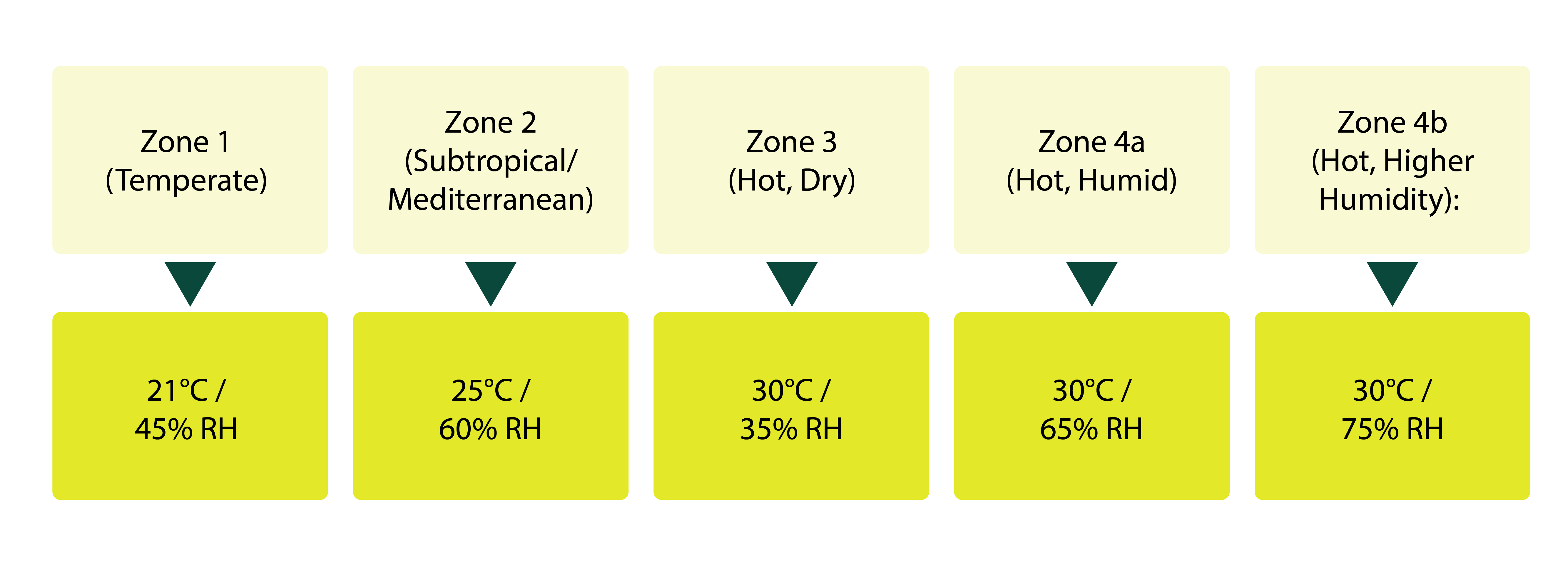
A product intended for global distribution must demonstrate stability under the storage conditions relevant to its target markets.
“In stability studies, we don't use just one storage condition. Instead, we elevate impact of temperature, humidity, and environmental conditions as recommended by ICH, storing products under multiple conditions to ensure they'll remain stable wherever they're marketed.” — Sudarshan
Temperature and humidity are not the only stressors. Light exposure can trigger photolytic degradation, particularly in sensitive molecules. In such cases, protection may be required throughout dispensing, manufacturing, and final packaging to prevent light-induced instability.
Comprehensive global drug stability testing ensures that shelf-life claims are supported by robust data. It confirms that the product will maintain its identity, quality, and purity across diverse climates, whether stored in temperate regions or high-humidity tropical environments.
Late-Stage Development: Scale-up and Process Validation Readiness
Late-stage development pharma marks the transition from laboratory-scale formulation to validated commercial-scale manufacturing. At this stage, the focus shifts to scale-up, reproducibility, and process validation readiness, ensuring the product can be manufactured consistently, in full compliance with regulatory expectations.
This phase includes the production of exhibit batches at commercial scale and preparation for formal technology transfer. The objective is not only to replicate laboratory performance, but to demonstrate that the formulation remains stable and robust under real manufacturing conditions.
“We must assess exhibit batches at commercial scale to prove we're ready for commercialization, stability assessment continues for at least 24 months, sometimes 36 or 48 months, until the product is truly market-ready.” — Sudarshan
Importantly, stability evaluation does not end once scale-up is achieved. Long-term data generation continues to confirm shelf life and support regulatory filings.
A comprehensive technology transfer package is then prepared to enable seamless movement to the receiving manufacturing site. This typically includes defined critical process parameters (CPPs), a documented control strategy, validated analytical methods, processing instructions, and stability data. Together, these elements ensure that the product can be reproduced reliably beyond the development environment.
Late-stage pharma development ensures that the scientific design meets regulatory accountability by proving that the formulation is not only effective and stable but also fully prepared for commercial production.
Formulation stability SHOULD take three months, and we cannot reduce that time just because someone wants faster results. While accelerated degradation testing at elevated temperatures can provide predictive data, that will not give a realistic picture of real-world performance.
Quality by Design (QbD) & DoE in Formulation Development
Quality by Design (QbD) brings structure to pharmaceutical formulation development by shifting the focus from trial-and-error to scientific understanding.
Instead of testing variables in isolation, teams define critical quality attributes (CQAs) early and identify the formulation and process factors that influence them. This reduces risk, improves predictability, and supports faster, data-driven decisions.
A core tool within QbD is Design of Experiments (DoE). Using structured approaches such as factorial screening, multiple variables (such as excipient levels or processing parameters) can be evaluated simultaneously to determine which factors truly impact product performance.
This approach aligns with regulatory expectations outlined in:
- ICH Q8 (Pharmaceutical Development)
- ICH Q9 (Quality Risk Management)
- ICH Q10 (Quality System)
- ICH Q12 (Lifecycle Management)
An important outcome of QbD is defining the design space, the scientifically justified operating range within which the product will consistently meet quality standards.
To explore how QbD strengthens formulation strategy and scale-up readiness, read our detailed article on Quality by Design in pharmaceutical development.
Conclusion
Successful pharma formulation development requires balancing scientific rigor with manufacturing realities. From pre-formulation studies and immediate-release tablet optimization to drug stability testing across ICH zones and technology transfer, each stage builds on the previous one.
At Strides, the philosophy is clear: pharmaceutical formulation development is a journey that must be respected, not rushed, with patient safety and product quality as constant priorities.
While this article focuses on immediate-release tablets, the same principles apply across broader dosage forms, including controlled-release and parenteral formulations. As a CDMO partner, Strides supports the full formulation lifecycle, from pre-formulation through development, scale-up, and technology transfer.
To learn more, speak with our team.
FAQs
1. How long does a typical formulation development programme take?
Early formulation stages typically require several months of systematic study. For example, pre-formulation compatibility and stability assessments alone may take three to four months to generate reliable data before full development proceeds.
2. When should stability studies start?
Stability assessment begins early in development and continues throughout the product's lifecycle. Initial studies help identify degradation risks, while long-term stability testing continues through scale-up and commercialization to support shelf-life claims.
3. What's the difference between accelerated and long-term stability testing?
Accelerated drug stability studies expose the product to higher temperatures and humidity to more quickly predict potential degradation pathways. Long-term stability studies, conducted under defined storage conditions, provide the real-time data required to confirm shelf life.
4. What typically causes tablet formulation failures at scale-up?
Common causes include unexpected excipient interactions, changes in powder flow or compression behaviour, and processing parameters that perform well in the lab but not at the commercial scale.
5. What does a technology transfer package include?
A technology transfer package typically contains detailed process instructions, defined critical process parameters (CPPs), analytical methods, control strategies, and stability data to ensure the product can be reliably manufactured at the receiving site.
References
-
Bajaj, S., Singla, D., & Sakhuja, N. (2012). Stability testing of pharmaceutical products. Journal of Applied Pharmaceutical Science, 2(3), 129–138.
-
Jain, S., et al. (2023). Drug–excipient compatibility study through a novel vial-in-vial approach. AAPS Open.
-
McMahon, M. E., et al. (2021). Considerations for updates to ICH Q1 and Q5C stability guidelines. AAPS Journal.
-
Jackson, K., & Young, D. (2000). Drug–excipient interactions and their effect on absorption. Advanced Drug Delivery Reviews.